Blog
(NOW CLOSED): Project Coordinator (Regional Food Group Lead)
Highland Good Food Partnership is looking to recruit a 2 days/week Project Coordinator (funded until end March 2027) to lead on activities relating to our status as the Regional Food Group for the Highlands. You can read more about our work as the Regional Food Group here. Do you have proven project coordination experience and an established network of business and enterprise contacts in the Highland good food sector? If so this role could be for you! Please refer to the full job description for more information. And feel free to get in touch if you’d like to discuss the role further. To apply, please send your CV, and a short cover letter (no more than 2 pages of A4) explaining the reason for your interest in the role, and addressing how your skills and experiences meet the person specification, to recruitment@highlandgoodfood.scot . The closing date for applications is 6pm on Thursday 18th June.
Strengthening Local Food Systems Through Venison
by Ele Forster, Project Coordinator (GFN Lead) Situated on the Logie Estate near Forres, it was a pleasure to cross the Highland/Moray border and drive through sunny, tree-lined lanes to arrive at this event. Over the last year, Brenna and I have been having a lot of online conversations around venison, so I really enjoyed meeting known people in analog, as well as finding new folk to discuss with. Many thanks to Scottish Venison for reaching out to us so we could come along and connect with this exciting development. The chill and processing unit is impressive in many ways, not least its small footprint. It’s clear Linzi and Tom of Findhorn Venison and Nikki and Jane, their butchers, have taken huge care to set this up well from the start, and now look after it with pride. It’s one of three venison processor recipients of a grant made available as part of the Covid recovery fund through the Scotland Food and Drink Partnership and administered by SAOS. With 50 of us, it was impossible to do a group tour of the chill, processing rooms and walk in freezer, but we ambled in small clusters – surrounded by varied and interesting conversations between the mix of attendees. I lucked out by joining a group including Nikki Wilkinson, Findhorn Venison’s main butcher. Nikki is engaging and enthusiastic – passionate about producing the best quality product with impressive traceability, and excited about the changes within the venison industry that are showing more women taking up roles in deer management and throughout the supply chain. In fact, several of the conversations I joined discussed the increased role of women – Jane had attended and loved the recent Hindsight camp for women that taught stalking, shooting and butchering skills. There was discussion around improving and maintaining the mental health of those involved in the venison industry. The skills gap was highlighted, especially in butchery, and the desire to engage and empower young people to get involved. I was struck by the attitude of collaboration at this event. So many different people and organisations have fed into this project that Tom and Linzi’s thankyous took a long time! There were several other venison processing businesses there, from the biggest scottish game dealers to micro producers, and all of them were sharing advice and encouragement with each other. In any part of the food system, it’s heartening to see people realising that by shortening supply chains and building a local market, there’s much room for collaboration across the region instead of competition. The room contained a great mix of landowners, stalkers, watershed organisations, processors, ecologists and venison industry advocates. Many talked about this shift in the industry towards collaboration – working together for higher deer welfare, quality product and more local people eating healthy meat from their own area. Lunch was truly amazing (shout out to Lethan Croft catering) and I was surprised and delighted to have a lively discussion about land rights, ownership and how different the culture can be in law depending on whether a deer belongs to itself, the landowner or the people. Discussions about food sovereignty are such an interesting space to explore psychology, history, politics and health. Several people touched on the Good Food Nation Act as a potential catalyst for getting local venison into school meals. Procurement is a sticky issue, but following the successes on this front in Argyll and Bute, we’re excited to hear that Highland Council has several pilots currently testing venison in Primary Schools. Watch this space! Seeing this set-up, with its small footprint but relatively large output (2 tonnes last year), I can’t help but hope this is a replicable initiative – with deer culls increasing nationwide, local processing infrastructure like this can be the key to empowering and connecting local communities with the quality meat that’s coming off their own hills.
(NOW CLOSED) Join Highland Good Food Partnership as a Trustee!
Passionate about sustainable food and local communities? This is a great opportunity to help shape the future of food in the Highlands. Flexible, voluntary role (meetings every 6-8 weeks) Contribute your experience in food, business or community development Help drive positive change alongside a dedicated team View the full role description here. If you are interested, please email hello@highlandgoodfood.scot to arrange a chat. Deadline: Midday on 12th June 2026
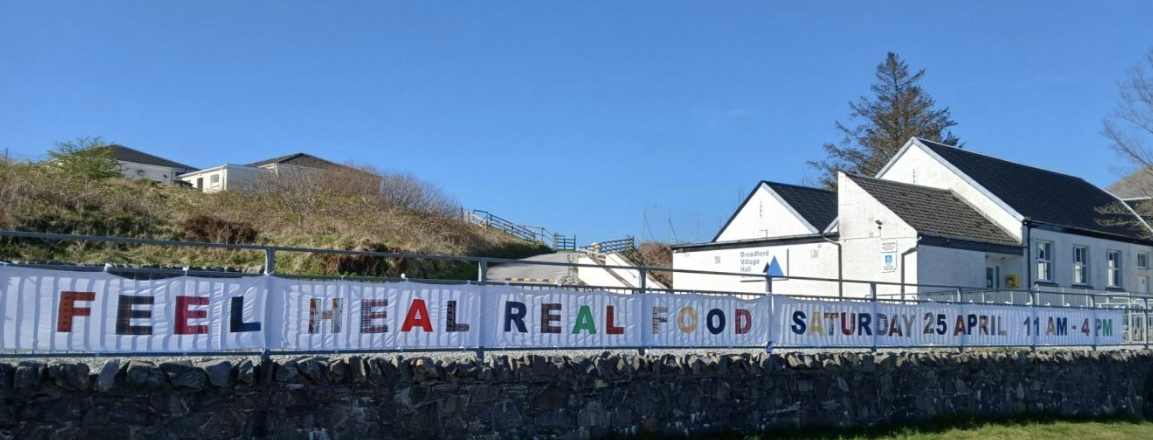
Feel Heal Real Food – A great event on Skye!
by Sarah Bowyer (HGFP Trustee) On a sunny morning in April Highland Good Food Partnership headed to Broadford Village Hall on Skye to support the event organised by ReRoot, a local group based in South Skye that has emerged from the Skye Climate Action network . As a separate group, focussing on the food system, ReRoot aims to inspire the creation of a more connected, healthy, sustainable and resilient food environment in Skye and Raasay. These aims underpinned the day providing the opportunity for sharing information, education and a forum for discussion, as well as eating and enjoying food prepared using predominantly seasonal and local ingredients. In the main hall Highland Good Food Partnership asked people where they ‘get’ their food from. Which included their shopping habits, access to community fridges, as well as any food they grow themselves at home or in community growing settings. We are using the answers gathered to update of our online interactive map to assist accessing food across Highland. Fellow stall holders included local food producers including West Coast Organics, Ellas Croft and Dun Flashadder Cottage Croft, local community food growing such as Broadford and Strath Community Company who have allotments near the Broadford hospital. The Scottish Food Commission also joined participants on the day to talk to local people and find out more about the food environment on Skye and Raasay. As well as the stalls, there was the opportunity to take part in a range of talks and activities from those skilled in growing food locally, including Raasay Walled Garden and members of the team from the Rowett Institute – the whole programme figuratively nurturing our ‘fields of hope’ for a better food system. Participants were nourished by tasty, healthy food prepared by local chef John Coghill, assisted by Corry Capers Outdoor Learning Group, and members of the Broadford Youth Club. John had designed a delicious menu showcasing planet friendly recipes developed by the Rowett Institute. ReRoot are very pleased with the initial feedback on the day and following collating of all the comments from the formal feedback forms, will use this in considering how they build on the momentum of the day, capture the impact within the community and plan the way forward. Congratulations to all of those involved in this fantastic day!
Behind the Mic: Making the Highland Good Food Podcast
by Fuggo King When I first volunteered to be the host for the Highland Good Food Podcast, I was stepping into new territory. Albeit one without passport control. The first episode I recorded was in May 2023, titled Worldwide Opportunities on Organic Farms. I was fortunate to be trusted by the partnership to choose the subject and interviewees. I decided to begin with a topic I had first-hand experience of and spoke to people I already knew. I was then ably supported by Rachel Butterworth as editor, who shared helpful tips that improved both our communication and the editing process in future recordings. By then, I was hooked. I love learning new things and speaking with people. Subsequent topics were shaped through meetings with the HGFP team, and useful contacts were often suggested. I would research as much as possible before conducting interviews. While I listened to a range of podcasts, I feel lucky that I was able to follow my own instincts and intuition when selecting interviewees. The episode I most enjoyed recording was the final one, on pollinators – partly because I met most of the contributors in person, but also because of the depth and range of knowledge shared. I also revisited many of the earlier HGF podcast episodes. One of my favourites from season one is episode three, Taking Control of Our Bread. As a long-time bread baker and user of organic grains, I was fascinated to learn more about small-scale bakeries and heritage grain growers. In season two, I particularly enjoyed episode two, which explored the impact of small businesses and individuals on the local food system. What I value most about podcasts is the opportunity for deeper engagement. Rather than skimming the surface of a topic, there is space for more thoughtful exploration. While images and short-form content on social media can inspire, more considered listening allows for richer understanding and can help avoid confusion or misunderstanding. Finding a balance – introducing topics in an engaging, accessible way while still offering depth – will be an exciting challenge for the next HGF podcast producer. One of the more challenging episodes for me was making the Good Food Nation Act and Plan accessible. If you would like to learn more about how this is progressing, I recommend reading the previous blog by Ele, which offers a clear overview of both the opportunities and challenges. There is no doubt in my mind that exploring more local, healthy and affordable food options is crucial for all communities. In a region like the Highlands, reducing food miles and offering alternatives to large online retailers and supermarkets is becoming increasingly important. Please continue to support local food where you can, and get in touch to contribute into the good food movement. For now, I’ll head back out into the garden to pot up some seedlings and reflect on my next learning adventure.
Sunshine, Shetlands and Shared Knowledge
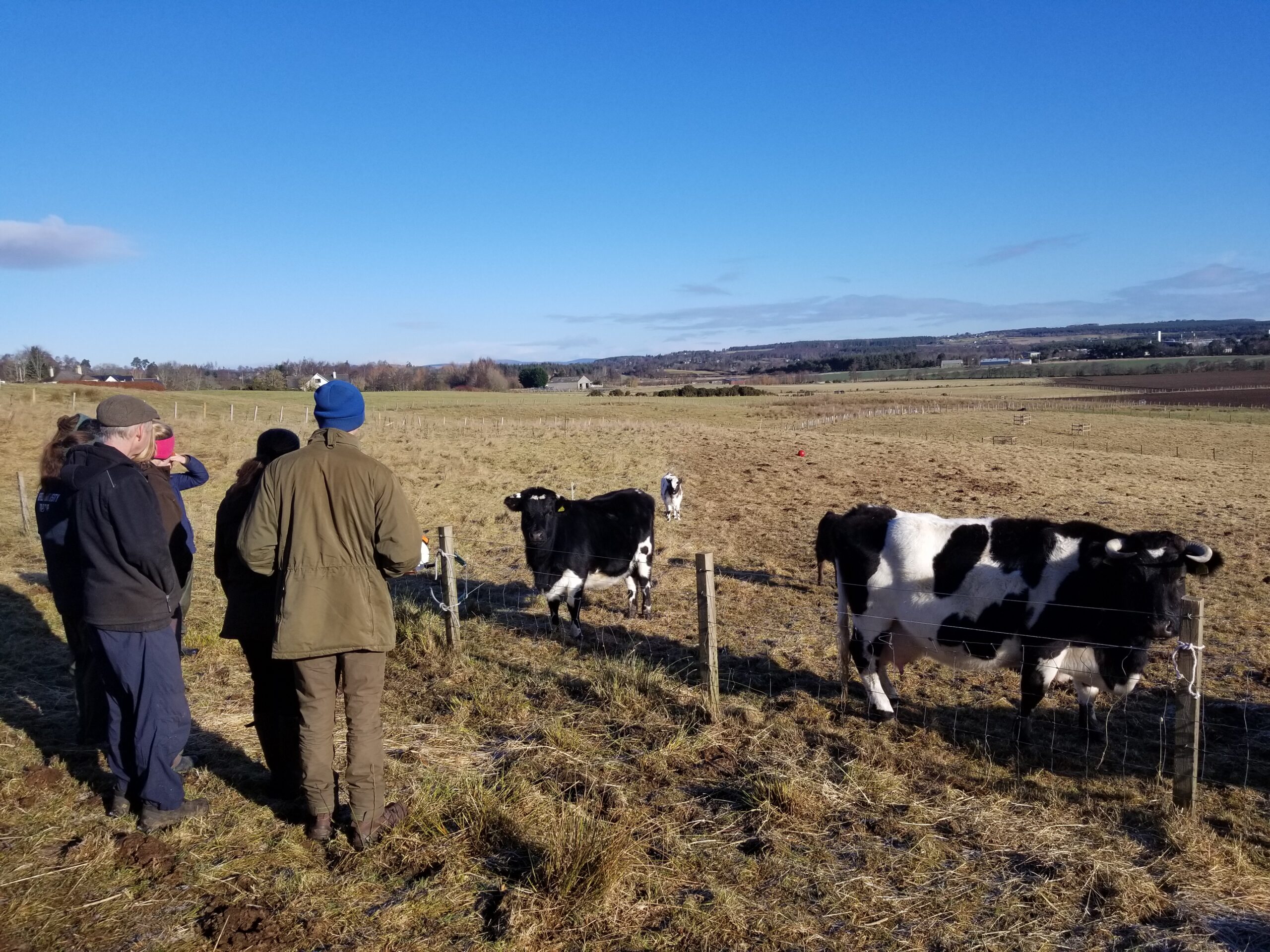
Sunshine, Shetlands and Shared Knowledge: Our First Farmer Cluster Connections Walk by Ele Forster Friday 13th was lucky for us as crisp, cold sunshine welcomed us to Carol Williams’ small farm near Muir of Ord. We were also fortunate to have James Yoxall from Grampian Graziers join us to bring his expertise to our first Farmer Cluster Connections farm walk. The driving idea behind the Farmer Cluster Connections project is that within our farming and crofting communities is a wealth of knowledge and experience. Much of farming is done in isolation, and there’s huge value in providing a space for producers to gather together to share knowledge, explore solutions and support each other. This concept was proven within minutes of pouring the coffee: conversations were flying and strangers were discovering common ground. Once we had everyone sat beneath Carol’s bundles of birch tree hay, we discovered our group had a range of place, size and focus of farms. James brought us back to the basic principles of regenerative farming: Minimise/optimise soil disturbance Keep the soil covered Maintain living roots year-round Maximise diversity Integrating livestock There is some criticism of ‘regenerative agriculture’ as too wooly a term, but there’s also a strength in a concept that allows farmers to build their soil health in a myriad of ways, that works within their own unique circumstances. There is no end point. We were pleased to get moving and into the sunshine, wandering down to see Carol’s Shetland cows. This being our first farm walk, I was worried that we’d run out of farm and conversation in the hours before lunch, but it turns out there is endless interesting discussion to be had in a field with some farmers, a few cows and a cat. Topics ranged from calving times, parasite management, gorse, water trough positions, abattoir regulations, electric fence use, shetland physiology, gut bacteria, tree planting, rushy ground, dealing with snow all the way to discussing being able to handle a bull armed with just a bit of white string. It was clear how useful it can be to have a chance to explore issues together, from the macro (climate change) down to micro (a recommend for a particular brand of water trough valve). As a non-farmer, I was blown away by how knowledgeable and innovative our attendees are, and how generous they were with their experience. It’s heartening hearing about their hard work and dedication in the face of difficult economic and environmental conditions – doing their very best by the animals and land in their care – but also sad to hear how much of a struggle it can be, especially in isolation. We really hope the Farmer Cluster Connections project can help link farmers and crofters up across the Highlands to increase support. Our flapjacks had worn off, and the warmth of Carol’s kitchen was very welcome as we tucked into an epic pot of soup. A discussion around the Farmer Cluster Connections project followed after lunch, along with a taste of honey from Carol’s husbands’ bees. This project is farmer-led. We have secured funding for farm walks, speakers, webinars and gatherings. Although there are 8 regions running concurrent Farmer Cluster Connections projects, we have the freedom to develop it in the way that brings the most value to Highland crofters and farmers. Some smaller geographic and interest-based clusters are evolving, and there also seems to be a desire to be able to connect with other producers across the Highlands who are trialling and learning about regenerative agriculture. Huge thanks to Carol for being such a welcoming, open host. We’re excited to see what this year brings us! If you’d like to be involved, check out the Farmer Cluster Connections page here.
2026: The start of a Good Food Nation?
by Eleanor Forster With the publication of the first National Good Food Nation Plan just before the winter break, things are now officially set in motion for our Council and Health Board to begin developing a Local Good Food Nation Plan for Highland. After many years of tireless campaigning from third sector bodies such as the Scottish Food Coalition, it’s exciting to see this important idea begin to come to fruition at the highest level: that food is a vital piece in improving everyone’s lives in Scotland and protecting our environment for generations to come and that to do so it is imperative to take account of the food system as a whole. For those of you who contributed to our process of consultation on the draft plan in 2024, you’ll know that there were some glaring omissions and ambiguities in the original. So how does the new plan compare? And why does it matter? Just in case you don’t have time to digest all 85 pages with accompanying appendices and supporting analytical publications, I’ve done my best to try and summarise and bring out some points pertinent to Highland (with the caveat that I’m no policy expert!). For those who want even less info, just head to the final sum up section, but if you’re after more detail (or to make your own opinion) you can find the full documents on the Scottish Government website. The National Good Food Nation Plan: Part 1 provides an overview of the current state of the food system in Scotland. The following descriptions of a vision of a Good Food Nation from various perspectives provide a simplified and inspiring picture of where such a policy could lead us. There’s nothing to disagree with here – it’s important to have a shared vision for a better future food system as the Scottish Government, Local Authorities and Health Boards begin working with this document to write plans, but also as a filter for their normal duties. I was impressed with a new section on inequalities, putting it at the forefront of this work – describing the breadth, importance and intersection of how inequalities affect players within the food system. Part 2 sets out the 6 GFN outcomes. These have changed slightly since the draft plan and in summary cover the following: A better food environment A sustainable food system A healthy population A strong food and drink sector A thriving food culture Global impact The intention is that the outcomes will be used as a ‘cohesive set’ to ensure that local and national government can use them to ensure that any food-related policy work is placed within the context of the whole system, having regard for all angles and players. Part 3 covers the measuring of progress. Sensibly, the ‘numbers’ part of this is in a separate analytical publication – very interesting for some, deadly dull to others. It’s worth mentioning the work that is going on behind the scenes by the GFN Living Lab to turn this indicator framework into a useful, evolving dashboard platform to allow LA areas to see how they match up to Scotland as a whole and track progress. As with the draft plan, there are holes in this Initial Monitoring Framework – they can only use existing targets and data – but it’s great to have it overtly recognised that there are evidence gaps and that this is an evolving framework. There is no set of GFN time-bound targets, though, only those involved as part of existing initiatives. Part 4 sets out the ‘policy landscape’ as I think it’s called. It does a good job of presenting it to someone like myself who has generally managed to avoid being involved in policy. Divided into three sections – People and Communities, Providers & Places, Farmers, Food Producers & Processors – it reads like another vision section, prompting me to look up a definition of ‘policy’ (statement of the government’s position, intent or action). There’s lots of useful links to relevant documents and initiatives that are now on my to-read list, so this new plan is definitely ticking the box of gathering related information into one place so someone new to food systems thinking can get a good overview of relevant policy. In the Conclusion, it is made clear that this is the first generation of GFN plans, and that there’s much work still to be done. There’s a specific mention of ‘the valuable work already started by third sector, community bodies and other organisations’ which is welcome, especially in the light of incredible work done by volunteers in food insecurity. It’s great to see all the right buzzwords in this document: ‘right to food’ ‘partnership working’ ‘regenerative’ ‘dignity’ ‘food waste’ and more. I couldn’t find any mention of supermarkets, but perhaps the stronger focus on food environments is to cover that in a non-confrontational way. One of the biggest criticisms of the draft plan was that it wasn’t a plan – just a vision along with a list of existing food-related policies. Unfortunately, in my opinion, that criticism still stands – although the new plan provides a strong vision of where we want to get to, and a clearer presentation of how existing initiatives and policies fit with each other within that vision and other related frameworks it still lacks time-defined goals or rigorous success criteria. We know where we want to get to, we (sort of) know where we are, but we don’t have a clear map of next steps and staged goals. I worry that without better leadership from the Scottish Government in taking new actions, much of the work is being left to the Relevant Authorities (Local Authority and Health Board) to make the vision reality, with (so far) minimal guidance and resource. To sum up, the new National Good Food Nation Plan is a definite improvement on the draft, with a strong vision of a sustainable food future for Scotland and a more coherent presentation of the existing policy landscape relevant to food. It’s got all the right buzzwords, and it’s a useful place to learn more about what our Government is doing around food. Does this plan have the detail and strength to lead us as a nation into that vision? Probably not. It’s a good first step in creating a systems-context for policy related to food, but the lack of a clear time-bound framework of goals means that there is a real risk that this could become mostly a paper exercise. It’s a huge win that the GFN has the legal clout of legislation. Its statement, that ministers must ‘have regard’ to the plan when making decisions does raise the question of what that actually means in terms of action, let alone the food system transformation we desperately need? Whatever the gaps and difficulties, the bottom line is that having food-system thinking built in at the highest level of our decision-makers is a welcome complement to the ongoing hard work of grassroots organisations, individuals and small businesses who push every day to improve our food system on the ground and make a sustainable food future for generations to come. And what does all this mean for us in the Highlands? Well, it does feel like we were taken into consideration when this plan was redrafted – there is now mention of rural inequalities and the role of geographical isolation in accessing good food. Our big industries of agriculture and fishing are part of the discussion, as well as the improvement of career desirability and access in the sector of food production. All important points. Now that the National Plan is published, both the Highland Council and NHS Highland have a duty to develop, consult on and publish their own Local Good Food Plan (probably by the end of 2027) and review and renew it in line with the National schedule. A key question is, with what money? Any new initiative takes resource, so we’ll be waiting with bated breath until February when it’s likely we’ll hear what budget will be available from the Scottish Government to fund the Local Plans. I wonder if it’ll be enough to pay someone to do a good job of writing the plan, let alone then having resource to execute it… On a more positive note, even before the new publication, the GFN process up to now has already reaped benefits – The GFN leads in Highland Council and NHS Highland are engaged, motivated and committed to working in partnership with HGFP and others to make the most of this opportunity. We’ve already done some good work together, joining dots and sharing learning and resources and I’m actually really excited to see where this process leads Highlands in terms of creating a strong partnership with players from across the food system. We’ll be working with THC and NHSH to identify all the levers available to them, looking to find a balance of low-hanging fruit and flagship initiatives within the priorities laid out in the 6 outcomes, and discover synergies where impact can be more effective. In the next weeks, we’ll be meeting to consolidate a shared strategic vision between the two organisations, and continue to strengthen the bones of our partnership. We’re so grateful to everyone who has supported Highland Good Food Partnership up to now and placed us in a position to make the most of this opportunity. As a food partnership with paid staff, we can help facilitate the link between stakeholders from all over the Highland food system, widening the impact of the GFN process. We are closely networked with food partnerships from across Scotland, and can learn from each other as we support and push our LAs to make this moment count. We intend to make good use of this juncture when THC and NHSH are duty-bound to consider the Highland Food System, and work to place the specific duties and levers of those organisations within the wider needs and desires of our Highland farmers, crofters, communities and businesses. We’ll do our utmost to ensure that this doesn’t just end up as another paper on a shelf. In the following weeks, we’ll be exploring what this plan means to us here in the Highlands in more detail, and as the work progresses, we want your voice to be heard loud and clear in the process of writing of a Good Food Nation Local Plan for Highland. In the meantime please get in touch if you’d like to be more involved: eleanor@highlandgoodfood.scot
Should we be pushing for everything to be organic?
by Katie Andrews (chair) At the Highland Good Food Partnership, our trustees have been reflecting on the conversations and feedback from our recent gatherings. One topic that keeps coming up is our view on organic farming and how it fits into the wider journey toward sustainable food systems in the Highlands. We’re proud to support organic farming and the values behind it – care for the environment, healthy soils, and thriving biodiversity. Reducing chemical use in agriculture is vital for the wellbeing of both people and nature. At the same time, we know that the route to organic is a journey, and there’s no single right path. What matters most is that we all keep moving in the same direction. Our commitment is to inclusivity: whether you’re working with organic methods, regenerative approaches, or other innovative ideas, you are part of this movement, and we want to support you. Over the past year, our podcast has featured voices from across the Highlands who are experimenting with regenerative and forward-thinking farming practices. These conversations have strengthened our belief that real change comes from collaboration, openness, and shared learning. However, we also recognise that terms like “regenerative agriculture” can sometimes be used loosely or for greenwashing. So, we think it’s important to be clear about what it means to us. According to Regeneration International, regenerative agriculture involves: “Farming and grazing practices that, among other benefits, reverse climate change by rebuilding soil organic matter and restoring degraded soil biodiversity – resulting in both carbon drawdown and improved water cycles.” The Progressive Farming Trust describes agroecological practices as methods that: Recycle plant material and farm residues to keep nutrients in the system Build and protect healthy soil Reduce losses through better water, soil, and energy management Increase plant and animal diversity Encourage natural interactions that support healthy ecosystems These are the principles we share and support. We will continue to champion approaches that reflect our values of sustainability, inclusivity, and community empowerment. If you’d like to share your thoughts or experiences, we’d love to hear from you. Get in touch – we may feature your story on our podcast or blog.
Reflections from the Highland Climate Conference 2025
By Ele Forster, HGFP Project Officer The Highland Climate Conference was held on the 8th October 2025, and was a fantastic opportunity to connect with inspiring people, share ideas, and raise the profile of the Highland Good Food Partnership (HGFP). Our chair, Katie Andrews did a wonderful job representing us, and it was lovely to see our trustee, Sarah Bowyer there too. Connecting and Learning One of the highlights was learning more about the NorthWest 2045 Regional Land Use Partnership and their community-led approach to shaping a shared vision for the future. Their focus on catalysing change – by sparking and facilitating conversations rather than delivering projects directly – resonates strongly with our own mission. It also made me reflect on the potential of building stronger networks of well-connected area partners. Organisations and individuals who share our values and can help us deepen our impact across the Highlands. Strengthening links with Community Planning Partnerships could be part of this approach too. Insights from Highland Adapts The team at Highland Adapts shared their latest publications, including Circular Economy Practices for Resilient Supply Chains and Economic Assessment of Climate Change Impacts. They’re currently developing a new piece of work – Risk and Opportunity Assessment – which they’ll be workshopping in December. We’ve signed up to take part and will be exploring how to bring a food focus into that discussion. Amplifying Voices A powerful theme throughout the conference was the importance of including young people and minority voices in the climate conversation. It’s not just about representation, it’s about ensuring meaningful involvement in shaping the solutions. Celebrating Collaboration Katie’s presentation went brilliantly, and it was heartening to hear HGFP mentioned positively by other speakers during the Q&A. There were also well-deserved shoutouts for the Highland Community Waste Partnership, recognised as a great example of collaborative work delivering real benefits on the ground. Final Thoughts The conference was full of insights, both about the climate and about how to run engaging, impactful events. And of course, the food was lovely too! Overall, it was an energising reminder of the power of connection, conversation, and collaboration in driving real change here in the Highlands.
Fantastic Highland Gatherings & HGFP AGM 2025!
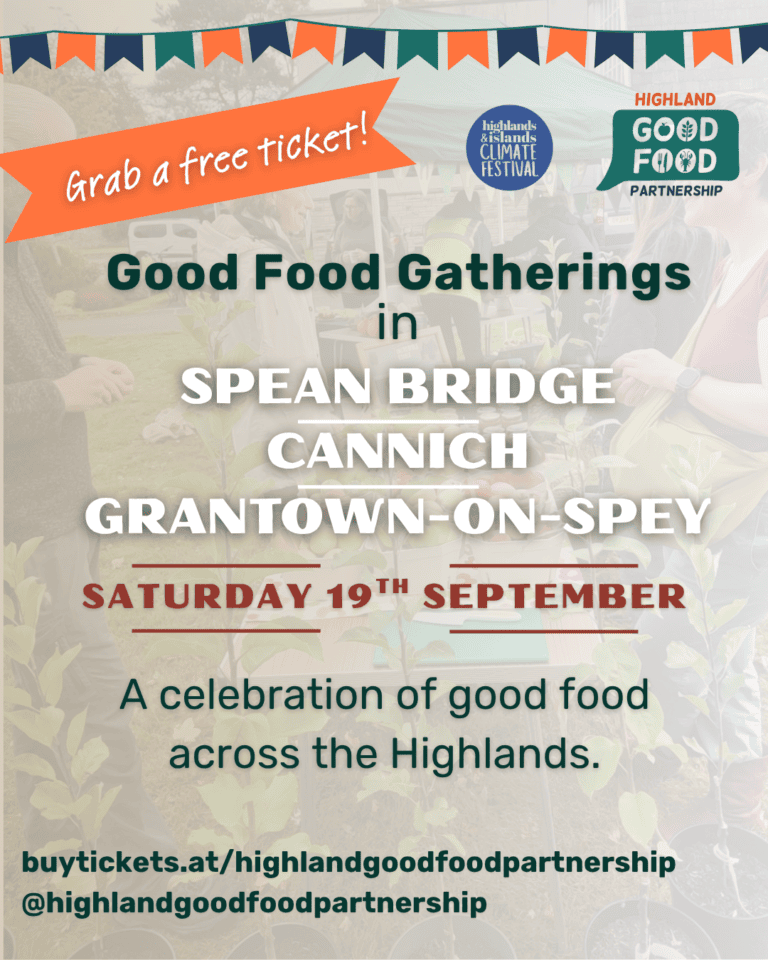
by Ele Forster We celebrated another successful year of our Highland-wide AGM gatherings on the 20th September. Designed to empower communities and make our AGM as accessible as possible. We’re very grateful to our event partners – Incredible Edible Inverness, Balmacara NTS, Highlands and Islands Climate Hub, Cairngorm National Park Authority and Knoydart Farm CIC for all their support, great ideas and hard work putting on these wonderful events with us. Each had its own focus and flavour, depending on what the community / partner felt was helpful for them: PLOCKTON GATHERING Plockton’s gathering, with Balmacara NTS had a focus on crofting, and we enjoyed lots of interesting conversations including exploring a local food hub, microdairy, venison supply chains, community composting and more. We heard about Balmacara’s ongoing feasibility study into some of these options. After a good feed of local produce from Off the Croft catering, we enjoyed a fantastic tour of a local croft. Balmacara NTS are a wonderful example of a large land-owner trying to strengthen the local community and food system using the resources they have access to. We’re looking forward to hearing more of their plans as they evolve. INVERNESS GATHERING We had a great gathering in Inverness, hosted by the wonderful team at Incredible Edible Inverness. We celebrated community food projects in Inverness and beyond. There were activities for all the family to get involved, with apple pressing proving most popular. It was great to see people of all ages interacting with the dig for tatties, apple tasting, tomato seed saving demo and plant swap. It was lovely to meet lots of non-members and have an opportunity to introduce Highland Good Food Partnership to those taking an interest in their community. KNOYDART GATHERING Being on the Knoydart peninsular, our gathering in Inverie, in partnership with Knoydart Farm CIC, was the most isolated. But due to the great turnout from the community, and our event coinciding with Just Walk (a walk from Skye to Glasgow to highlight land rights issues), we had over 50 people joining us for a delicious lunch of Knoydart venison stew! The morning saw staff from the Highland Council Waste Management team engaged in conversation with members of the Knoydart community about waste issues. All waste currently has to be carried off the peninsular by boat, including food waste. An existing pilot project between the Farm and Forge (community owned pub) has proven the potential for in-vessel composting of food waste on site, and we’re excited to be supporting the exploration of a larger project that would cater for more of Inverie community. AVIEMORE GATHERING Our Aviemore event was organised with the Highlands and Islands Climate Hub and the Cairngorm National Park Authority, to provide space for them to strengthen their Community Grower Network, which was created earlier in the year. As part of the morning, we were shown around the local Badenoch and Strathspey therapy garden at Aviemore Community Hospital. The project manager of the therapy garden encouraged us to all think of how we can make our community growing spaces more accessible through the use of things like long-handled trowels and table-top potting activities. We then tucked into an amazing lunch from Speyside Kitchen and Bog Bakes. A big thank you… …to all who helped and took part! Due to the wonderful activities our partners helped organise, we had over 40 people at our actual AGM (as well as those joining us online) and we met loads of folk who had not heard of HGFP and are now signing up to be members. We really enjoy the process of engaging with new community organisations each year, and working with them to develop an event which meets a local need in the theme of local food. We try to spread out our events throughout the Highlands, so please do get in touch if you’d like to help host a gathering with us next year!
(NOW CLOSED) We are hiring a Chief Executive
(NOW CLOSED) Job Opportunity: Chief Executive The Highland Good Food Partnership (HGFP) is looking for a Chief Executive to help us grow and strengthen a fairer, healthier, and more sustainable food system in the Highlands. About the Role Salary: £22,500 (£45,000 FTE) Hours: 17.5 hours per week (2.5 days) Location: Home-based, with some travel required Contract: Funded for an initial 3 years This is a unique opportunity to make a real difference to food and community life across the Highlands. We are seeking someone who is both passionate about food sustainability and compassionate in their approach to leadership. As Chief Executive, you will: Lead and coordinate HGFP’s work to support a thriving, resilient food system. Collaborate with partners to shape a Highland food strategy. Deliver Regional Food Group and Sustainable Food Places objectives. Build strong relationships across public, private, and community sectors. Secure resources and opportunities to sustain HGFP into the future. You’ll be joining a small, committed team and a wide network of partners who care deeply about the future of food in the Highlands. Together, we aim to inspire positive change and create practical solutions that work for everyone. The full job description and person specification are included here. How to Apply Please send your CV and a short letter explaining your interest in the role to recruitment@highlandgoodfood.scot. Closing date: Friday 5 September, 6.00 pm Interviews: 11 – 12 September, Inverness
Meet The Producers (2025)
Meet the Producers Tour | Inverness & the surrounding region by Brenna Anderson On 2nd April, we were thrilled to host our Meet the Producers Tour, in partnership with Visit Inverness Loch Ness, and what a day it was! With spring sunshine on our side, we visited some of the incredible local producers that make our region truly special. From farm tours to product tastings, the day was a celebration of local food, connection, and community. Stops on the tour: South Clunes Farm Highland Hill Larder Black Isle Brewery and Garden Loch Ness Honey Company Loch Ness Ice Cream Each stop offered a glimpse into the dedication, innovation, and care behind the produce we’re so proud of. We ended the day with a delicious lunch featuring the very best of local, seasonal produce, a perfect way to round off a day of discovery and connection. To the amazing buyers who joined us: your enthusiasm and support for our local food system is truly inspiring. We’re already looking forward to the next one! We’re excited to share the online version of our Local Producer Food & Drink Trail map, developed in collaboration with Visit Inverness Loch Ness and our incredible network of local producers. Explore the trail and connect with the people behind the produce! This event was part of the ‘Showcasing Scotland Local’ series of events supported by Scotland Food and Drink. These events are designed to grow sales of Scottish produce by bringing together buyers and suppliers to do business across the retail, wholesale, hospitality, and independent sectors. Images credit: Eoghan Smith Photography
What do regional food groups actually do?
The Highland Good Food Partnership is the Regional Food Group for the Highlands. But what does that actually mean? by Martin Sherring, Trustee of the Highland Good Food Partnership The Regional Food Groups are a network of local organisations, representing food and drink businesses. Highland Good Food Partnership has been the Regional Food Group for the Highlands since we started in 2021. The network is managed by Scotland Food & Drink, and funded by the Scottish Government. The task of the Regional Food Groups is to “enable sustainable growth and collaboration in local, Scottish markets”. That is certainly an aspiration we share, but we also want to do more. We want food to be produced and distributed in ways that are better for our health, and better for the environment. This is reflected in our diverse membership, whereas most of the other Regional Food Groups’ members are all food and drink businesses. As part of our Regional Food Group role, each year we agree with Scotland Food & Drink a range of activities we will be working on. This year that includes: Developing a local food culture in the Highlands. This year we developed the Black Isle FEAST; a weekend festival of local food, and we enjoyed a visit to Taste of Nairn earlier in the year. We’re keen to help similar events throughout the Highlands. If you’re involved in a Highland local food event yourself, or interested in helping set one up, do get in touch. Helping growers who are interested in switching to more environmentally-sensitive methods. We are impressed with Propagate’s Regenerative Farming Network in SW Scotland. This started as a group of 20 growers and has now grown to 250 – and we’d love to see something similar in the Highlands. In October, we went on a learning exchange to Dumfries and Galloway. We met Abi Mordin of the Propagate network, and some of their members. Strengthening relationships between Highland producers and buyers. With the Black Isle FEAST, restaurants featured the great produce on their doorsteps. But we think there’s still scope for hospitality businesses – and other buyers – to use and promote our great local producers. At the moment we’re working on this in collaboration with Visit Loch Ness/ Inverness – and hope to work with other parts of the Highlands. Promoting more of our food businesses. We’re working with five Highland food and drink producers to give them some more exposure – and will be looking to do more of this. If you are interested in being featured, let us know – and if you become a business member (for free), you can also feature on our Highland Good Food map.
Towards An Ecological Bread System
Original published by the Pebble Trust blog by Col Gordon, a farmer’s son, seed researcher, baker and Trustee of Highland Good Food Partnership, who’s based on his family’s farm in the Scottish Highlands. Cereals and bread are central to the majority of diets across the western world. Until relatively recently however, both cereals and bread have been curiously absent from conversations and strategies about local and ecologically grown food. This is largely because of how much work is needed to enable this to happen. The current bread system and its associated problems Around 80% of the bread sold in the UK today is made using the “Chorleywood process”. In this ultra-efficient process wheat flour is transformed into a soft, fluffy loaf with the help of a cocktail of additives and E-numbers. Between mixing the raw ingredients to the finished loaf coming out of the oven, the whole process takes just over an hour. This has enabled the production process to to be very well suited to large mechanised factory settings, enabling very cheap products to be offered. The wheat that is required to produce suitable flour for the process needs to be very ‘strong’ and is very difficult to grow in UK conditions. Because of this the majority of the bread wheat used comes from Canada and, until very recently, Russia, Kazakhstan, and Ukraine. Bread is often used as a “loss leader” by supermarkets, who market it at prices below the production costs to encourage customers into their stores and to purchase other items. This strategy of making the cheapest possible form of bread has had many knock-on effects. These include an exponential increase in gluten intolerance and instances of people developing autoimmune disorders such as coeliac diseases. This is primarily due to what is essentially a complete absence of a fermentation process resulting in eaters trying to digest raw gluten. Another side effect is the almost complete collapse of the local grain system within the UK. In every Scottish postcode there would once have been access to a grain mill to transform locally produced grains into foodstuffs, malt, and animal feed. In the move to “get big or get out” these once common local food systems have been replaced almost entirely with global commodity markets. Today the only market that’s readily available to arable farmers are commodity markets where their grain is bought and sold in 29 tonne widgets that can be transported by artic lorries. In Scotland, it’s worth noting that these markets are generally geared around supplying the lucrative whisky industry with its raw materials. At the moment most arable farmers sell to these markets, not necessarily because they want to but because this is the only available route to market. An industry like whisky will prioritise yield above all else and farmers have little option but to respond to this. They are rewarded for yield per acre. A farmer may choose to grow a crop using ecological principles in order to increase nutritional or flavour content of their crop, but unless they can find an alternative route to market, the commodity system will not reward them for their troubles. The implications of this for the twin climate and biodiversity crises are significant. The seeds that have been bred in order to achieve their astonishing yields have been bred to thrive alongside chemical fertilizers. As the plants are extremely short and have almost non-existent root systems, they are generally unable to compete with other plants (weeds) and so tend also to be susceptible to fungal diseases or attacks from pests. This can mean that herbicides, fungicides, insecticides, nematicides and growth regulators are required in addition to fertilizers. The result of this is that most of the arable fields you see today are made up of a single variety of a single species and contain little to no biodiversity. A 2017 study by the University of Sheffield found that the use of ammonium nitrate fertilizer makes up 43% of the entire green-house gas emissions embedded within a loaf of bread including transportation. A much-shared headline from a few years back read that because of these systems our soils only have 60 years of harvest left in them. While this may be hyperbole, it is the case that soil fertility is being eradicated very quickly and that our current methods of production are not sustainable. Add to this the changing and extreme weather patterns, it’s clear that, in the long run at least, drastic changes need to be made to make our bread systems more resilient and adaptable. The opportunities: According to Andrew Whitley of Scotland the Bread, significantly less than 0.1% of the 900,000 tonnes of wheat grown in Scotland is used for producing bread. Another way to think about this is that the roughly 500 tonnes of Scottish wheat which is made into bread, doesn’t come close to even half a percent of the total flour in bread consumed in Scotland. The implication is that even if the amount of wheat grown and used in bread in Scotland expanded to 10 times the volume currently produced, we’d still be a good distance off approaching 5% of the total potential market share. Whilst I’m in no way an advocate for growthism in a way which capitalist logic dictates, what is clear is that the market for bread and baked goods made from ecologically grown grains needs to drastically expand in order to facilitate a shift to more sustainable, ecological cereal production. The barriers: Appropriate seeds There are currently about 33 accessions or lines of wheat seed that are commercially available to Scottish farmers. My understanding is that not a single one of these has been bred specifically to function well in organic situations or to thrive without heavy inputs. The seed stock for low-input, low impact systems doesn’t exist commercially at the moment. A growing number of people are realising that for a healthy, resilient system we need more genetic diversity in these fields. Rather than having single varieties of a crop, having dozens, or even hundreds, of different varieties in one field makes for a much more resilient and robust system. If a pathogen or pest attacks one variety, you still have all the others. One way to access this diversity is by using “heritage” varieties that are often tucked away in gene banks. These seeds did function well in no-input systems and did grow well in specific regions. We should not necessarily look to return to these grains entirely, but they are likely to play a crucial role in allowing diversity to return to our arable systems. My old mentor John Letts, who was one of the pioneers in the heritage grain movement, often uses the phrase “In diversity there is strength”. The late, great, plant breeder Martin Wolfe paved the way for a new approach to cereal breeding based on the principle of diversity by creating his famous YQ population where a dozen or so wheat varieties were crossed together in every way possible to create hundreds of new varieties which are all grown together, constantly evolving and adapting to the conditions they find themselves in. By tapping into the genetic possibilities of these older forgotten grains it may be possible to create appropriate seed for a low-impact and thriving future. This isn’t helped by current seed legislation, where for any seed to be legally marketed it must demonstrate varietal purity that can be identified as distinct, uniform and stable. This means that diversity, adaptability, and therefore resilience, are not legally possibly within current seed legislation. This is a huge barrier to legally scale ecological grain production. Rebuilding lost infrastructure In order to reinvent local grain systems appropriate infrastructure is required to handle and process these seeds. To turn grain into bread, it first needs to be transformed into flour. In Scotland there are only a handful of small scale, regional mills left across the whole country, whereas in the past nearly every community would have a mill. This bottleneck needs to be addressed for local grain economies to function and to create new routes to market for farmers. Interestingly, there are new artisan and sourdough bakeries popping up all over the place and increasingly these bakeries are interested in using local, and ideally ecologically grown, grains. More farmers are looking into how to transition to more sustainable methods and to find new market options. Without the infrastructure to mill, or malt or oil press at a local or regional level these things just can’t happen. Creating networks of markets Increasingly networks are being developed to overcome these challenges and build local grain economies in ways that are based on relationships rather than faceless commodities. We’re starting to see initiatives where all sorts of bakeries and farms within a region are working out how to collaborate and work cooperatively. It’s still embryonic but we’re beginning to see mills re-emerging across most regions in the British Isles. If the reinvention of ecological bread systems is approached in a ‘small is beautiful’ way, it will only ever be a relatively exclusive product. Given the centrality of bread and other grains in our diet we need to be ambitious in the scale of impact we are aiming for. It’s not OK for healthy bread grown in healthy arable systems to only be available to a privileged few. To turn the “artisan” into the mainstream and to enable it to become readily available will require collaboration and cooperation throughout the supply chain. This will enable more farmers to transition to more ecological practices, which in turn will have positive ecological impacts on more acres. What I’m doing I’ve been working on this issue for over a decade trying to understand what a route map for making our arable systems more sustainable might look like. For the past 8 years or so I’ve been trawling through gene banks and have grown and tested around 6000 different types of old wheat from around the world. Over the past few years on my family’s farm, Inchindown, in semi-upland Easter Ross, I’ve been growing fields with mixtures of around 200 different types of wheats and ryes all grown together without any inputs. With the generous support of The Pebble Trust I was able to purchase a Austrian stone mill to enable the transformation of this grain into flour. This will then be mixed with water and salt and fermented with wild yeasts, shaped, and loaded into my purpose built commercial woodfired oven to become sourdough bread. It’s been a long time in the making but this June will see the 1st Inchindown grown flour falling from the mill and loaves being pulled out of the oven. As much as anything I see this as a proof of concept or a prototype which may act as a stepping stone to enable more folk from across the Highlands to collaborate and re-imagine what the grain system and our bread system could be. To see more from Col Gordon, visit his Linktree To find out more about the Pebble Trust, visit their website here.
NOW CLOSED: New Trustee!
NOW CLOSED: Come and join the team as a Trustee THIS POSITION HAS NOW CLOSED. We have an exciting opportunity to join the Highland Good Food Partnership as a Trustee! We are looking for someone to join our existing seven Trustees to help develop a sustainable food system in Highland. Job Title: Trustee for Highland Good Food Partnership Location: Highland, United Kingdom Type: Voluntary Time Commitment: Flexible, with a minimum of one Trustee meeting every 6-8 weeks on Zoom (online) and potentially time for supporting Highland Good Food Partnership activities (not required). Purpose of the Role: As a Trustee of Highland Good Food Partnership, you will be responsible for helping guide the organisation’s strategic direction and ensuring it fulfils its vision to promote sustainable food practices and support the health and well-being of the Highland communities. For the full job description, key responsibilities and application process, click here DEADLINE IS Friday 28th June at 1200.
Katie Andrews makes connections at ‘Taste of Nairn’
Our Trustee Katie Andrews makes connections at Nairn’s annual food festival – Taste of Nairn On a bright, sunny morning, I travelled from Inverness to Nairn to attend the ‘Taste of Nairn’ Saturday event. I was keen to connect with some food and drink businesses in Highland and promote the Highland Good Food Partnership. I started in the Community and Arts Centre, where stalls filled the room displaying home-baked goods, fresh fruit and vegetables, vegan pastries, and much more. My first thought was, where do I begin?! As I made my way through the room, I was drawn to Loch Ness Honey. I shared with them the story of the Highland Good Food Partnership and our map, a testament to the vibrant food activity across the Highlands. They, in turn, shared their own story – a business with over 100 bee colonies spanning from Inverness to Moray. Their passion for their craft was clear. Next, I met Craig from the Ord Oak Smokehouse, a man on a mission to promote sustainable fishing and inspire the next generation to join the industry. I sampled their smoked mackerel pate, a true delight! After chatting with some more people in the Centre, I decided to meander down Nairn High Street, where the sun was shining and stalls lined the car-less streets – a real treat!! I saw some of Highland Good Food’s existing members, including Rose Cottage Country Kitchen. I was then joined by fellow HGFP Trustee, Sarah. We continued down the High Street speaking with some potential new members, including the Isle of Skye Baking Company. We bumped in Lucy, Nairn BID Manager, and congratulated her on a fantastic event! On our way back to the Centre, we chatted with Macleod Organics, one of the Highland Good Food Partnership’s supporters (and a guest on our recent podcast episode) and long-standing members. We spoke with Judy, who told us about the company’s exciting transition to a Cooperative! I needed to head off, but Sarah took a couple of HGFP business cards and walked down to Nairn Beach and the Pavilion, where there were more activities taking place. I treated myself to one of the Vegan Skinhead’s haggis sausage rolls, a perfect lunchtime indulgence. What a fantastic morning, it was great to see so many people connecting with local businesses and enjoying local, sustainable food. There was a real sense of community when wandering through the stalls and hearing the buzz of people enjoying themselves in the sun. Congratulations again to Lucy and the team for putting on a truly brilliant event. I can’t wait for the next one!
WWOOF and the National Minimum Wage Law
How have WWOOF hosts been affected by the recent changes to the National Minimum Wage law? (WWOOF – Worldwide Opportunities on Organic Farms) Our podcast host, Fuggo King, has been an integral part of the WWOOFing community for quite some time now. You may recall her insightful podcast episode – Season 4, Episode 1: Worldwide Opportunities on Organic Farms. Here, she shares her thoughts on the recent changes to the National Minimum Wage law and the guidance provided to hosts by WWOOF. “I am a WWOOF host and have loved being part of this mutual exchange community built on trust and sharing. Fair wages for workers are very important and the volunteer sectors in the UK must be aware and take note of new legislation. Here is some news from the WWOOF team. Long live WWOOF! “ – Fuggo. Recent update provided by WWOOF UK for hosts: After the recent changes in the law we felt we needed to temporarily put new memberships on hold until we had a better idea about the implications for WWOOF. We’ve now sought legal advice and believe the strategy we are creating should mean WWOOFing in the UK can continue. The strategy will take elements from other WWOOF groups around the world. In the short term we’ve realised we must clarify the relationship between host and WWOOFer, making sure the WWOOFer cannot, in any way, be viewed as a worker. This will be reflected in the website in the very near future. We will also be working with all hosts to make sure that the opportunities you are offering – and the manner in which you are offering them – can be considered to comply with National Minimum Wage legislation. To be 100% clear we are now saying WWOOFing visits can continue for all hosts, not just those which are charities or CICs. Further Reading: More Information provided by WWOOF UK LWA blog post – TRAINEES, VOLUNTEERS AND THE LAW
Farmer clusters in Scotland by Fiona Torrance
At Highland Good Food Partnership we believe there is great scope for farmers to collaborate together to achieve more than they could individually, and the “Farmer cluster” is one model for that. This blog post was written by Fiona Torrance, Farmland Biodiversity Advisor, Game & Wildlife Conservation Trust Scotland , who kindly gave us permission to share it. The original is on the Game & Wildlife Conservation Trust website. Last year I was given the unenviable challenge of developing farmer clusters in Scotland. Although farmer clusters have been going in England since 2012 and have been immensely successful (with over 100 connected to GWCT now established) unfortunately in Scotland we have not seen this same level realised. So why is this, and what can we do to kick-start their uptake in Scotland? The farmer cluster model is one that, with the correct support in place, has the potential to deliver multiple benefits for both wildlife and people. Collaborative projects are nothing new, but what sets clusters apart is their bottom-up approach, meaning that the groups are run and managed by the farmers themselves. This means they select their own facilitators, select the species/habitats they want to work on (with advice from their facilitator), and organise their own meetings, visits and other events. PepsiCo FAB project farm walk. (Credit: Fiona Torrance) Traditionally, these are groups of farmers who live locally, who can then work together to enable conservation measures to take place on a landscape scale, a strategy which research tells us is far more effective than working in small units. However, there may also be other benefits for the farmers themselves, including sharing of machinery, access to a trusted advisor, as well as the opportunity to interact with your neighbours and other stakeholders. Groups such as these also tend to be great at learning from each other, with many farmers choosing to listen to advice from their peers rather than external sources. Sounds like a win-win right? If that’s you, then you might be wondering why this concept has not taken off in Scotland. After all, much of the farming system and wildlife present in the north and south of the border is similar. A potential answer to this question is money. In order for a cluster to get off the ground, three key ingredients are needed: a group of farmers willing to work together, one of these farmers who is willing to take on the mantle of leading the group and, crucially, a facilitator. The facilitator role in a cluster is key. Not only is this person trusted by the farmers to provide advice on how to conserve their agreed species or habitat of choice, but they also fulfil roles such as organising external speakers, coordinate any training required and, crucially, apply for funding so that the group can undertake some of their desired outcomes. In England, facilitators are supported through the Natural England Countryside Stewardship Facilitation Fund, but currently no equivalent funding exists in Scotland, meaning clusters must source their own funding before they’ve even hired an expert on how to do this. It is true that other funding models exist. For the clusters that have managed to get off the ground in Scotland so far, they have all selected funding models suited to how they work. This might include applying for short-term grants from the Scottish Government, self-funding, or partnering with a private enterprise, such as the PepsiCo FAB project, which I facilitate myself. However, it is clear that the desire for facilitation funding is strong. In a survey completed by the EU Interreg PARTRIDGE project in 2021 targeted at land managers in Scotland, 43% of respondents without an Auto Enrolment scheme and 59% with one, said they preferred to get advice from a cluster. Since the Countryside Stewardship funding was launched in 2015, they estimate that 225 groups with nearly 6,000 members have applied for facilitation funding. It is clear that Scotland has both the people and potential to make clusters a success, but without appropriate funding, options can be limited. So what is the current Scottish Government’s position? In December, the GWCT head of policy in Scotland Ross MacLeod appeared before the Scottish Government’s rural affairs committee to discuss the forthcoming Agriculture and Rural Communities Bill. During the session, farmer collaboration was discussed, and we were delighted to see that many other stakeholders in the room also agreed on the benefits they bring. It is hoped that the Scottish Government will see this too, although with the current pressure on public spending, this is an unenviable challenge for them. This all sounds a bit doom and gloom but I am quietly optimistic. Working with farmers across Scotland gives me a lot of hope when it comes to clusters. Since the first Scottish cluster, the Strathmore Wildlife Cluster, was set up in 2018, interest in this area has massively increased as word has spread. There are many dedicated individuals and groups working diligently under the radar, and the GWCT hopes to introduce additional support mechanisms to help clusters gets off the ground. As I mentioned in a recent podcast with the Highland Good Food Partnership, groups such as farmer clusters provide an opportunity for a more cost-effective way for society to deliver benefits for wildlife, and we hope that this is recognised sooner rather than later. A great starting point with lots of information on farmer clusters, is the GWCT Farmer Cluster website. For those looking for advice on where to start, the Scottish GWCT advisory team is now approved to undertake Farm Advisory Service specialist advice plans for biodiversity and woodland management. These plans (up to £1,000 from the Scottish Government) allow land managers to assess their current landscape and identify actions that can be undertaken to improve it for biodiversity. For more information on the service, see the Farm Advisory Service (FAS) website and to discuss an assessment, please contact the team.
Hearst & Gaither / AGM: 30th September
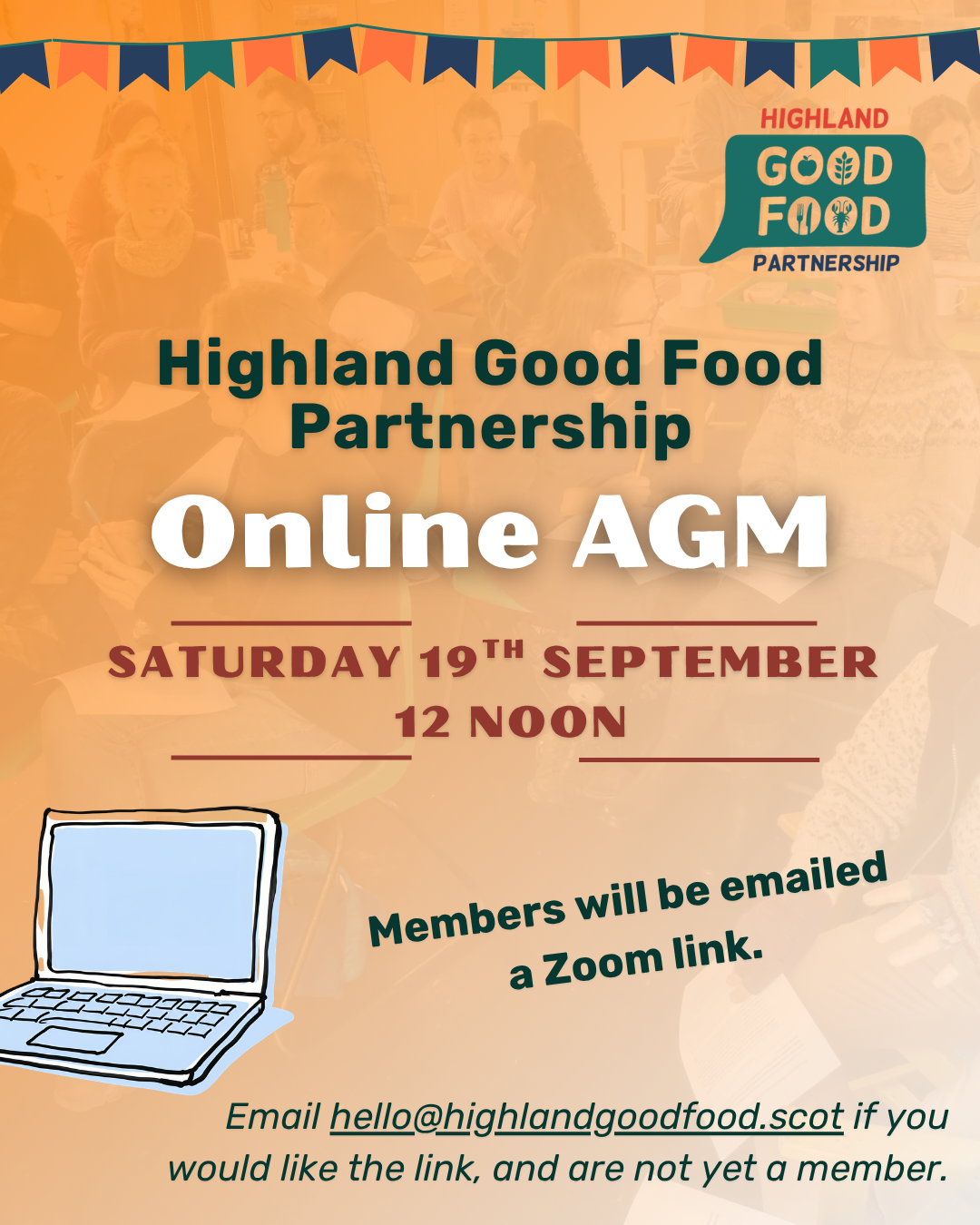
Hearst & Gaither + AGM We’re delighted to announce a Highland-wide gathering to celebrate the work of HGFP, our communities and all things good food on the 30th of September! This year we’re making it super easy to take part, with several simultaneous gatherings happening at regional hubs across the Highlands including: ELPHIN** LOCHABER & INVERNESS We hope you’ll be able to join us! It’s a great opportunity to meet like-minded folk in your area and celebrate and share local, sustainable good food. We’re planning all sorts of fun: workshops, discussions and maybe even a bit of a ceilidh. You have the opportunity to make your hub celebration whatever you’d like it to be, so get involved! Drop us a line at hello@highlandgoodfood.scot If you can’t make it in person but would like to be involved in the AGM, it’ll be an inspiring half-hour packed with info about the work we’ve done this past year and our exciting next steps towards a strong, sustainable food system that works for everybody in the Highlands. Join us online: Highland Good Food Partnership Online AGM – Sign Up! Come along online as an individual or a group. Why not make it an event? There’s funding to help you celebrate good food with your community! We’ve teamed up with the Highlands and Islands Climate Hub to celebrate local, sustainable food as part of their Highlands & Islands Climate Festival. You can hold a community Hearst and Gaither (literally Harvest and Gather) to bring your own community together and share local food together. Applying is simple but time is flitting and the deadline for applications has been extended to the 18th of August. ** Accommodation available – bunkhouse style accommodation with a kitchen and showers (£10pp/pn). Email hutbookings@gsg.org.uk and quote HGFP gathering to book. Your gathering can be as big or small as you’d like, from a full community feast to a few folk gathering brambles and eating pie! There are already plans afoot in various places like Broadford, Ardgay and Abriachan, so keep your ears open. If the 30th doesn’t work for your celebration, you can hold a Hearst and Gaither anytime in September. Apply for funding now! (NOW CLOSED) We really hope you can get involved: 1) Attend a regional AGM hub celebration on the 30th of September 2) Join our AGM online from your own community Hearst and Gaither 3) Host a Hearst and Gaither on another day in September We’d love to hear about your plans and see how we can help. Get in touch: hello@highlandgoodfood.scot
AGM 2023 Agenda, Minutes & Documents
30th of September 2023 This years AMG was held as part of a Highland-wide gathering to celebrate the work of HGFP, our communities and all things good food alongside a short online AGM meeting. With several simultaneous gatherings happening at regional hubs across the Highlands, here is a recording of the AGM. Relevant documents for the AGM: AGM Agenda Treasurer’s Report Accounts for year ended 31 Mar 2023 Trustees for re-election AGM presentation
Black Isle FEAST update
Black Isle FEAST update A great afternoon out at the Black Isle Brewery with lots of enthusiasm and excitement surrounding the potential of organising a ‘Black Isle Feast’ – a challenge to test whether the area could become self-sufficient in food and drink. Jon Palmer from the Cromarty Cheese House got the ideas flowing with his presentation and there were lots of great suggestions from participants. The project is supported by HIE’s Food & Drink TechHUB, and Claire Munro presented details of this scheme. Here are some of the key points: > The ‘Feast’ event could be integrated with the planned Black Isle Food and Drink Festival, to be held in September. > Involving schools in a menu competition could be a nice way of engaging with a younger audience. > There is an opportunity to connect the ‘Feast’ with the creation of a Black Isle Food and Drink Trail. Feast presentation pdf Tech HUB presentation in support of this project Next steps are to harness some of the afternoon’s energy, and actually make it happen! Keep your eyes peeled for more updates – If you would like to get involved, please send us an email at hello@highlandgoodfood.scot (more…)
Day of Action
Day of Action Highland Good Food headed to the Scottish Parliament on October 25th to support the Day of Action, organised by the Landworkers Alliance, Nature Friendly Farming Network, Propagate and Scottish Crofting Federation. The event was a great success and was organised to highlight why the up and coming Scottish Agriculture Bill needs to recognise and support the work of crofters and small farmers. We heard from amazing speakers during the day; Alastair Macintosh spoke about the importance of agriculture in human communities and culture, Bryde from Falkland Kitchen Garden spoke about their project and producing good healthy food for over 100 families, on less than 3 hectares. One of the issues with the current agriculture subsidy system is that if you have less than 3 hectares, you are not rewarded. This was something that was raised during the Day of Action, and something we are asking to be changed in the new system. Many crofts – and particularly horticulture businesses – are run on land that is less than 3 hectares yet contribute so much to their local communities; whether thats through the food they produce, benefits to communities, local work and nature restoration. We took with us some supportive messages from Highland Good Food Members, who were showing their support for crofters and small farmers. Check out our booklet that we took to Scottish Parliament with these messages: SupportSmallScale
Highland Good Food Gathering
Invitation to the Highland Good Food Gathering You are invited to the Highland Good Food Partnership’s weekend gathering at The Shieling Project on Saturday 24th September. This event is also part of the Climate Fringe Festival 2022. The day will include an introduction and update on the work of HGFP, with opportunities for people to discuss different food system issues. This will be followed by a selection of workshops and talks covering a range of topics for you to choose from. Topics include seed saving, land use in Scotland, fermentation and food storage, funding tips and tricks, and more! Nourish Scotland will be hosting a workshop of the new Scottish Agriculture Bill. This will be a great opportunity for members to learn about and feedback on the Ag Bill consultation. Please bring your own picnic lunch and to finish off the day we will have a locally sourced meal prepared by the Shieling Project and a campfire with some tunes – bring your instrument! There will be a kids’ club during the day for children to attend. Find out more about this exciting event and get your tickets via the link: https://www.eventbrite.co.uk/e/highland-good-food-gathering-tickets-390464428617
One Year On
One year on from the Highland Good Food Conference It has been just over a year since the Highland Good Food Conference where individuals and organisations from across the Highlands came together across five wintery Mondays to discuss how we could transform our local food system. So much has happened since then, so we thought we would give you our top seven highlights! 1. Sustainable Food Places Shortly after the conference, Highland Good Food Partnership (HGFP) became a member of Sustainable Food Places (SFP) – who are now one of our main funders – which is a network that brings together pioneering food partnerships from towns, cities, boroughs, districts and counties across the UK. Highland Good Food covers a huge and predominantly rural and sparsely populated area and it’s been great to connect with other partnerships that are similar to us in this way, e.g. Dumfries and Gallway. That said, it’s been really inspiring to hear what partners are doing in cities and urban areas and drawing comparisons in our work. Some of Highland Good Food’s main objectives are influenced by our SFP membership. These objectives include facilitating and enabling a sustainable food movement across the Highlands, engaging with community planning partnerships, identifying key policy asks from Government as well as developing relationships with a range of Highland Council services (welfare, food waste, education, community, climate change, procurement, planning). Our coordinator went to Edinburgh to meet up with some of the Scotland SFP members last year, for a day of strategy, feedback and looking forward and it was a welcome start to in-person meetings again. Sustainable Food Places is a partnership programme led by the Soil Association, Food Matters and Sustain: the alliance for better food and farming. It is funded by the Esmée Fairbairn Foundation and The National Lottery Community Fund. 2. Regional Food Group As the Scotland Food & Drink Regional Food Group for the Highland region, we join an amazing network of local food groups all over Scotland working to support the local food and drink sector. Increasingly, people are looking to buy local food – where they live or where they visit – and we work to promote regional food businesses and encourage purchasing of local produce. As the Regional Food Group we work with food tourism businesses and one of our main aims is to support the development of sustainable practice in this sector, from circular economy and food waste reduction to encouraging local supply. 3. Formalising the group After the conference it was clear we needed a formal organisation to coordinate and support the changes everyone was keen to see. This meant recruiting trustees, drafting a constitution and applying to the Office of the Scottish Charities Regulator, which we did in April 2021. As a SCIO (Scottish Charitable Incorporated Organisation) we are able to employ staff, take on assets and liabilities and apply for grants – so we can act as an “umbrella” for members’ food-related activities. 4. Recruiting a staff team In July 2021 Highland Good Food Partnership officially employed its first staff. Josie, who some of you will remember from the conference, took on the role of Project Support Officer while a new face, Catriona was employed as the Highland Good Food Partnership Coordinator. Since then we have had a few new people joining the team. Laura started as a volunteer for our involvement in COP26 events and is now a recognisable voice on our new podcast episodes. She also has the fun job of organising events for the Partnership! Most recently, Reina has joined our team as the Highland Community Waste Partnership (HCWP) Project Officer for HGFP. She will be working to reduce food waste through collaborating with communities and other organisations across the Highlands. 5. COP26 In November 2021 we took part in Nourish Scotland’s Fork to Farm Global Dialogue at COP26 in Glasgow. The dialogue brought together farmers, food producers and policy-makers from around the world to enter into meaningful dialogue. The aim of the event was to build mutual understanding and cooperation in order to work towards creating resilient and sustainable food systems. Individuals from the Highland Good Food Partnership were there in person whilst a small group joined the event online from the Highland Council offices in Inverness. We enjoyed an opening ceremony streamed live from coastal Kenya before partaking in conversation with food groups from Brazil and Mexico. It was truly fantastic to connect with groups from across the globe and find similarities, and learn from the differences, in our food systems. As part of COP26, local and national authorities were asked to sign the Glasgow Climate Declaration. HGFP encouraged our partners to be bold leaders and with great delight The Highland Council became a leading signature of the declaration. A beautiful graphic by Jem Milton who attended the Global Fork to Farm Dialogue in Glasgow and captured the highlights from the day. 6. Community Food Growing Strategy The Highland Council recently developed and released their Community Food Growing Strategy, called Growing Our Future. This strategy was catalysed via the community empowerment act, where one of the outcomes was that Local Authorities would have to develop a community food growing strategy. HGFP endorsed this strategy and supported The Highland Council in their efforts to build capacity by employing a Community Food Growing Officer. In the strategy you’ll find some great projects around Highland that are all doing amazing work around community food. There is a great diversity among the projects too. At Highland Good Food we are complimenting some of the work done in this strategy by developing a resource consisting of all community food growing projects in Highland to facilitate a knowledge, best practise and supportive exchange between projects. We’re excited to work with Highland Council in the future on wider food system strategies that will include many more of the key aspects of a resilient food system. Thurso Grows community garden. 7. Highland Community Waste Partnership Earlier this year, Highland Good Food Partnership was announced as one of the eight community groups coming together across the Highlands as part of a new climate movement to help reduce consumption and waste. The Highland Community Waste Partnership, coordinated by Keep Scotland Beautiful, and funded by The National Lottery Community Fund, will raise awareness of the relationship between consumption and climate change, and work over three years to create solutions to address this. HGFP is one of eight partners in the project. The others are: The Lochaber Environment Group Broadford and Strath Community Company Ullapool Community Trust Thurso Community Development Trust Lairg & District Learning Centre Velocity Café and Bicycle Workshop Transition Black Isle We have loads of resources on our website for you to learn more about what is going on in the Highland food system; we are on our third podcast season and we have many blog posts hearing from those on the ground, making the changes we need! Delve in to find out more and if you’re interested to be involved, become a member of the Highland Good Food Partnership.
Highland Farmers Disappointed at NFUS request for Moratorium
The National Farmers Union, Scotland (NFUS) released a statement last week calling for a moratorium on support scheme rules to allow crops to be grown on Ecological Focus Area land. Highland farmers have expressed dismay at the suggested relaxation of environmental rules and highlight some of NFUS’ ‘deeply flawed’ logic. An Ecological Focus Area (EFA) is an area of land upon which you carry out agricultural practices that are beneficial for the climate and the environment. The main aim of an EFA is to improve biodiversity, using the following practices: leaving land fallow, field margins, growing nitrogen-fixing crops such as peas and legumes, growing catch crops, green cover, implementing agro-forestry and sustaining or planting hedges. NFUS have stated that their concerns over global food security due to the humanitarian crisis caused by the Russian invasion of Ukraine have promoted this moratorium request, where they suggest current EFA land should now instead be turned over to “grow cereals, nitrogen-fixing protein crops such as peas and beans or grass”, all for use as livestock feed. Note: nitrogen-fixing crops are already part of EFA schemes. Col Gordon, farmer near Invergordon and a director of Scotland the Bread said: “I’m very disappointed to read of the NFUS’s request for this moratorium. At a basic level, with around 80% of Scotland’s cereal going towards alcohol production and animal feed and less that 0.1% of Scottish wheat being used for bread, the logic that in order to “address the growing concerns around future food security” we simply need to grow more crops is deeply flawed. But for NFUS to use the tragic and ongoing humanitarian crisis to attempt to push through a potentially far-reaching change in agenda is, unfortunately, shameful.” Legumes provide additional protein sources for livestock. Currently Scotland imports much of its additive feeding, largely used in intensive livestock systems. The cost of this feeding (soymeal and others) is currently very expensive (3 year high according to Markets Insider) with import prices for high quality protein feed likely to rise. NFUS stated that taking land out of EFA would equate to a maximum of 17,500 hectares (25,000 rugby pitches) liberated for their suggested usage. That many rugby pitches seems a lot, but in fact it’s only 4% of what is already used for cereal production in Scotland. Currently approximately 470,000 hectares of land in Scotland is used for cereal or oilseed crops, 80% of which is used for alcohol or for animal feed. Much of EFA land is near ditches, often poorer land on the edge of arable fields and it is suggested that this would not be suitable for growing cereals and grains. Donald Ross, ex-chairman of Highland Grain and mixed farmer from Easter Ross said: “I feel the aims of NFUS have been very poorly communicated, particularly on their slot on the radio. A lot of EFA land on my farm is poorer land, with much sandier soil. It is used for growing grass and therefore feeds livestock already.” Ariane Burgess, Scottish Greens MSP for Highlands and Islands said: “I share Highland Good Food Partnership’s concerns about NFUS’ call to allow crops to be grown on Ecological Focus Land. I don’t accept that it is necessary or proportionate to allow this on the basis that the Ukraine situation is driving food insecurity meaning we need to produce more crops. This is not a question of there not being enough land to deliver food security but how the current crop is being used.” George Monbiot writes in the Guardian (16th of March) and highlights some of the similarities between this ask to bring land set aside for nature into production and the call from some MPs to resume fracking due to the energy crisis. He comments that in both cases, the ‘environmental damage would greatly outweigh the tiny increment of production’. If food security is of such concern to NFUS, perhaps they should be calling for some of the huge proportion of land used for alcohol production (mainly to earn export income) to be redirected towards growing crops for people to eat. We should be moving towards more environmentally friendly farming (including importing less high carbon footprint crops, to feed animals), and many businesses are already doing this. This should be our focus.
Wester Ross Pocket Orchards Project
by John Wood A ‘pocket orchard’ is a small group of community fruit trees which are accessible, where possible, to local residents with no, or minimum driving. The inspiration came from the community orchard in the garden of Cromarty Courthouse Museum, the wonderful gardens at Inverewe, and noticing some neglected apple trees in an overgrown corner of Poolewe. Apart from fruit, the orchards are intended to provide spaces and spring blossom to lift people’s spirits, create some hope for the future, and encourage pollinators. The basis of the idea is that people and the planet cannot be separated and must work together for mutual benefit. We aim to build an abundance of resources for both people and the planet in a landscape that has been so badly damaged over the last 200 years. Food production is therefore only one of several objectives. So far, the pocket orchards project has planted 250 fruit trees in Wester Ross, across 32 sites. Nine of these sites have been planted at or in conjunction with local schools – Ullapool and Plockton High Schools, and Badcaul, Balnaluib, Poolewe, Kinlochewe, Shieldaig and Applecross primaries. We hope to add trees at Lochcarron and Gairloch primary schools next year. The biggest orchard so far is at Gairloch High School with 37 trees; the smallest is a single tree, trained on the wall of Bridge Cottage cafe in Poolewe (the original tree, planted in the winter of 2016/7). Blossom, spring 2021 on the original tree in Poolewe. This tree (Katy) started to produce crops of apples in 2020. Other sites where the pockets orchards can be found include Old Inverasdale school, now a community owned building, Torridon and Gairloch Youth Hostels, Poolewe Village Hall, Laide Community Wood (2 sites), Inverewe (NTS), Kinlochewe church, St Maelrubha’s church Poolewe, Ullapool allotments, and on public amenity land at Laide, Autbea, Poolewe, Gairloch, Badachro and Kinlochewe. The school’s orchards already provide educational benefits. In due course, there will also be social activities and training in tree propagation and care, building a local skills base and creating opportunities for community-focussed events and activities that will help bring people together and help build confidence. Local people will be able to harvest the fruit to make jam, pies, and more. Beekeepers will benefit from increased yields of honey, and a revived insect population will pollinate other plants and trees, building biodiversity more widely. Perhaps the presence of the trees will inspire crofters and others to start growing trees themselves and provide a basis for a small but circular and sustainable economy. The majority of the trees are apples, of varieties carefully chosen to suit Wester Ross conditions with a focus on non-commercial ‘heritage’ varieties. There are also plums, pears, cherries, cornelian cherries, cherry plums, two chestnuts and a walnut. The main suppliers have been Andrew Lear in Perthshire and John Hancox in Glasgow. There have also been individual donations of trees. The project is currently taking stock of progress so far but the intention is to resume planting in 2022, both expanding existing orchards and establishing new ones. Key plans for 2022 also include completing a delayed grafting workshop on a croft near Poolewe which marks the start of the propagation of endangered old local varieties. We also hope to build community engagement through a volunteer network. The plan is to move towards more locally grown trees from local stock. Perhaps in the longer term there might be opportunities to start developing new varieties that are both productive and resilient in Wester Ross conditions. The project has been able to go ahead thanks to the project founders, those who donated to the crowdfunder, the Highland Council’s Ward Discretionary Fund, The Pebble Trust, the Woodland Trust, TCV, Ovo Energy and other, private, donors. ______ To find out more or get involved with the project, visit the group’s Facebook page: https://www.facebook.com/pocketorchards Or get in touch with them via email: pocketorchards@gmail.com
The Road From Paris to Glasgow is through the farm gate!
by Emma Whitham As the anticipation and excitement builds in the lead up to COP26 in Glasgow this November, we all know this is our best chance to get the world on track to tackle climate change. During these last few weeks, it has felt like the full fury of the climate crisis has appeared almost everywhere at once. From the deadly heatwaves in Canada to devastating deluges hitting northern Europe, from raging forest fires in Siberia to record-breaking rainfall in China. It has been plain to see that nobody and nowhere is immune to the changing climate. 2021 is a historically significant year with our world leaders being faced with the monumental task of bridging the gap between countries’ current climate commitments and the significant transformation needed to tackle the climate and nature emergencies. With citizens from around the world having high expectations for COP26, the big question is, can we as a global community take the action needed to achieve net zero and be climate prepared before it is too late? Our future is dependent on us getting this right and matching our action with the reality we face. We must all play our part in this massive call to action. Food and farming account for almost a third of greenhouse gas emissions and there’s no way to meet the Paris targets without changing the food system. The road from Paris to Glasgow goes through the farm gate. Furthermore, the changing climate is threatening global food security. “Observed climate change is already affecting food security through increasing temperatures, changing precipitation patterns, and greater frequency of some events.” IPCC Special Report – Climate change and Land [1] The Farming for 1.5C inquiry published their final report [2] last week and encouragingly the main message is; it is possible to reduce emissions, increase biodiversity and maintain production. Change is inevitable, the nature of the climate and environment emergencies requires us to redefine the role of farmers. No longer are we just asking farmers to produce food, we are asking them to deliver for nature and the climate too. This inquiry has brought all key players together and collectively they have agreed that agriculture must become part of the solution, not part of the problem. So, we are agreed, we must change how we farm, what we eat and how much we waste – and at the same time provide good food for everyone and good jobs in food. That’s why we need joined-up action on food at every level, from local to global. The Glasgow Food and Climate Declaration aims to bring the commitment of food systems transformation to COP26 as an integrated solution to the climate emergency, with co-benefits for biodiversity, ecosystem regeneration, circularity, access to sustainable and healthy diets for all, and the creation of resilient livelihoods for farm and food workers. The Declaration is a commitment by local governments around the world to take joined-up action on food to tackle climate change, and a call on national governments to do the same. It is vital to have local and national governments working together on this – national governments must set the direction, whereas local governments are in touch with their citizens every day and can make a real difference to what happens on the ground. For example – working with local farmers and growers to supply the food for schools and care services, providing land for market gardens in and around towns, connecting local food producers with shops and cafes, running local projects to reduce food waste, making veg and fruit more accessible and making our weekly shop more sustainable. “Only a food systems approach can identify effective interventions to accelerate climate action while delivering many co-benefits.” Glasgow Food and Climate Declaration [3] The Highland Council recently signed the Declaration, making it one of the first Local Authorities in Scotland to join this global movement and commit to supporting and enabling food systems change. The Highland Good Food Partnership is delighted with this progress and plans to work closely with the Highland Council, communities, farmers, crofters and food businesses along with other public bodies to do food better. We can do this – together! What to know more? 1] IPCC Special Report – Climate Change and Land – https://www.ipcc.ch/srccl/ 2] Farming for 1.5C – from here to 2045 – https://a7353cf8-3f00-4057-ba25-219e031620a6.usrfiles.com/ugd/a7353c_db9fa0546fb2487dbf014e8cc4865019.pdf 3] Glasgow Food and Climate Declaration – https://www.glasgowdeclaration.org/
Greenhouse growing: local Mediterranean veg in the Highlands
by Josie Fraser, Researcher and Writer for HGFP Each year the UK imports around half of the food it consumes. Roughly 80% of these foods come from the EU, with Spain as one of the top sources for our fruit and vegetables. 95% of these imports make it to the Highlands via the port of Dover [1]. What is the problem with this? With so much dependency on food coming from elsewhere, we leave ourselves vulnerable to shortages when there is a disruption to the supply chain. We have had only a taste of this through Brexit and the pandemic over recent years, but crises resulting from climate change such as major floods which could prevent transportation of these foods from Dover to the Highlands are becoming a more realistic and serious threat. The environmental impact of these imports are also a problem due to the miles the food has to travel from where it is produced to our dinner plates; emitting more carbon than local alternatives. And due to the hotter climates in regions such as Spain, where we have outsourced most of this food production, a huge amount of water is used for its growth. The issues of imports go further still, including the competition it creates with local farmers (who are forced to reduce their prices due to cheaper imports), slave labour in some countries exporting to the UK, and the carbon emissions that the UK is transferring to other countries who produce our food. What can we do? Whether it be due to the increasing concern about the impact of our food choices on the environment or the role of the pandemic in highlighting the fragility of our food system, there has been a recent increase in the number of people eating locally-produced food. But are people ready to give up their Mediterranean favourites? Tomatoes, chillies, peppers? Perhaps we don’t have to… Of course the Highland climate prevents the growth of most of these foods outdoors during most of the year. However, other northern countries such as Finland, Norway, the Netherlands and Canada are practicing a clever solution: Controlled Environment Agriculture (CEA). CEA is a high-technology and scientific approach to agriculture which enables producers to control the environment that the food is growing in. Producing food in closed agricultural systems enables control over temperature, light, water, carbon dioxide, nutrients and pests to create the optimal conditions for growth. This enables year-round growing of some of our favourite foods, as the cooler climate and shorter winter day-length in the northern regions are no longer a limiting factor in their production. There are many different methods to grow in these controlled environments, with benefits associated with each. Research from the Netherlands, a country with glasshouses that can cover up to 175 acres, shows that growing hydroponically in CEA glasshouses can save up to 90% on water use compared with open fields [2], as the resource is carefully recaptured and recycled. The process is extremely efficient – in fact the Netherlands now find themselves producing more tomatoes per square mile than any other country, producing an astounding 144,352 tons per square mile, as well as producing the highest yield of chillies, green peppers and cucumbers [2]. Thanks to the high-tech and automation innovation, this efficiency has led the Netherlands to be the second largest global exporter of food by value [2], despite their small size. A view over the Westland region of the Netherlands. Source: holland.com To find out more about CEA and the greenhouse industry in the Netherlands see the resources at the end of this page. CEA in the Highlands At the Highland Good Food Conference earlier this year, a group of innovative Highlanders who were passionate about this topic started a project to create a CEA greenhouse sector in the Highlands, and since then they have been working to make it a reality. The aim of their project is to displace the imports of these Mediterranean vegetables by growing them here in the Highlands. You can watch the group’s presentation of their project from the conference here. Since the conference, the group have been doing their homework; they have been researching and contacting projects elsewhere in the world, including Wageningen University & Research (WUR) in the Netherlands and Kauppapuutarhaliitto, a growers association in Finland who have CEA greenhouses further north than the Highlands; the success of which demonstrate how controlled heating and lighting can overcome limitations and extend the growing system at our latitudes. They have also been following the many research projects in the sector, including those at WUR, but also one much closer to home that some of the commercial growers in the group are involved in. They are investigating the nutrition level in vegetables produced hydroponically compared with those grown in soil; an interesting study that could help the group to determine which of the many growing mediums to use in their greenhouses. So far, there is an indication on some measures that soil grown vegetables have 10x the nutritional value of those grown hydroponically. Within the project there is a real desire to innovate. For example, along with a larger growing unit, the group is following the idea of ‘satellite production’ where multiple smaller-scale greenhouses would be installed in communities across the region. It is commonly said that CEA greenhouses need to be at least 1 hectare; any less and the infrastructure is underused and there is an economic disadvantage. However, the group wants to challenge this by adapting existing technology which would allow smaller greenhouses, better suited to the rural communities across the region. These satellite units would work with input from (and in collaboration with) the larger unit(s), as well as create more jobs in food production. The group aims to use natural methods of production within their greenhouses and to heat them using renewable energy, including smart grids and storage which are progressing in the renewable sector, in order to keep their environmental impact to a minimum. From their research, they have been impressed with the highly collaborative approach taken in mainland Europe, and the pride these growers take in helping one another. The innovation and solutions within the industry are a product of collaboration between different producers, and researchers. This demonstrates that working together can have quite exceptionally positive consequences. The Highland group hopes to use this co-operative approach in their own project. The group’s plan for the next 12 months involves developing a business plan to set up a growing unit and an umbrella organisation to bring growing units together as well as creating growing plans to best meet the Highland demand for these foods. For now, we will have to wait for our fresh Mediterranean dish made with locally produced veg in the Highlands, but I know I am not alone in my anticipation. Want to know more? [1] How dependent is the UK on the EU for food? – A BBC article looking into the UK’s dependency on the EU for food, particularly during the pandemic. [2] This Tiny Country Feeds the World– A National Geographic article exploring the greenhouse industry in the Netherlands where we meet some of the pioneers in the sector. Yes, Indoor Agriculture Can Feed the World– An interesting read about the benefits of CEA indoor growing. Glasshouse Vegetable Production in the Netherlands– a 30 minute video exploring the innovation and technology behind the success of the industry in the Netherlands. Read about Scotland’s first vertical indoor farm at the James Hutton Institute and Nourish Scotland’s article, Vertical farming to secure food for the future?, which looks at the pros and cons of this facility. And if you’re interested in statistics around imports and exports, you can read the UK government’s Food Statistics in your pocket: Global and UK supply.
Highland Good Food CONFERENCE 2021
The conference has now ended for 2021. You can read up about what happened at the conference on our blog posts here (Blog 1) and here (Blog 2). You can watch all project presentations on our YouTube Channel here, or click on the individual links below: PROJECT 1: Develop a producer owned retail co-operative. PROJECT 2: Develop a Highland-wide online market / food hub. PROJECT 3: Work towards a world class restaurant sector. PROJECT 4: Develop a lobbying policy group ensuring the Highland voice is heard. PROJECT 5: Work towards every school in Highlands growing, cooking & eating their own food. PROJECT 6: Develop a Highland wide community food growing network. PROJECT 7: Work to big up small farms in the Highlands. PROJECT 8: Develop a Highland Circular Food Economy / Zero Waste. PROJECT 9: Explore marketing and promoting local Highland Food as a brand. PROJECT 10: Creating a thriving ‘glasshouse’ sector in the Highlands. PROJECT 11: Seed sovereignty in the Highlands. The conference was just the start of the Highland Good Food journey, so if you would like to get involved in the next stages, then subscribe to our mailing list here. CONFERENCE REPORT & APPENDICES: Highland Good Food Conference Report 2021 Group 8.pptx Highland Good Food Conference Report Appendix
The Finale of The Highland Good Food Conference
The Highland Good Food Conference is now over. What an incredible five weeks of discussions, learning, collaborating and passion working to create a food system that is better for the planet, people and producers. Days 1-3 took us through enriching discussions based on vision setting, keeping people at the heart of the food system and how to produce local food more sustainably. You can read about the first half of the conference in our last blog here. Day 4 was all about finance. We had six fascinating provocations that took us through innovative ways to source and use money in support of a better food system. Would you invest 25% of your pension pot into better food production and receive your pension not in pounds but in a healthier, more secure future? This was one provoking question asked on Day 4. There was a very strong focus on solutions lying within the community; from a community owned wind co-op generating money to communities coming together to use their spending power to support local businesses. Day 5 was kicked-off with an inspiring provocation from our very own steering group member, Dennis Overton: “Making positive change is one of the most rewarding things you can do in life. But change will come not only by talking, action must follow, and there are 11 action groups here in this conference ready to do that.” Some great comments from delegates about their experience of the conference! Now to these all-important action groups As we mentioned in our last blog, delegates have been working in themed action groups since Day 2 of the conference, developing ways that their group can contribute to achieving this fairer food system. These groups cover a diversity of topics; from seed saving to lobbying policy, restaurants to community food growing, producer-owned cooperatives to food waste, Highland food marketing to growing food in our schools. And even creating a new glasshouse sector to grow Mediterranean veg for everyone, here in the Highlands. There certainly was no lack of ambition when delegates formed these groups. On Day 5 each of the 11 groups presented action plans with aims and visions of what they believe they can achieve beyond the conference. We heard some fantastic, big ideas. For example, one group aims to produce vegetables grown in glasshouses in the outskirts of Inverness to produce year-round growing while another wants to resolve food waste issues by installing Big Hanna composters in 100 villages and districts across the Highlands by 2025. By working within the same conference, distinct projects found how they could link up and build a more resilient food system together. Recordings of each group’s presentation will be made available so if you want to find out more about their action plans then keep an eye on our website! You can also have a look on our social media, particularly our Twitter to read highlights of each group’s aims and visions from Day 5. The end of the conference marks the end of Phase 2 of the Highland Good Food Partnership. We will shortly be commencing Phase 3, where we will be taking action to make the food system in the Highlands fairer for all.
The Highland Good Food Conference So Far…
by Josie Fraser, Researcher and Writer for HGFC We are over half-way through the Highland Good Food Conference and what a truly incredible three days it has been! Over ninety people from not only the Highlands & Islands but the borders of Scotland and even the south coast of England have joined to share ideas and inspirations to create a Good Food system here in the Highlands. Of course our conference is taking place virtually but this is what enables so many people to join and we couldn’t be happier! So what is the conference all about? Many of us are becoming more aware of the need to improve the food system here in the Highlands. Why? Well, as we all know by now, climate change is a serious threat across the planet but there is a lot that can be done to reduce the most serious effects. One thing we can do is create a more sustainable, or regenerative, agricultural system. But climate change is happening alongside a social injustice: right now, Scotland faces a nutritional crisis as not everyone has access to fresh, local and healthy food. The motivation for this conference goes further yet as many local producers in the Highlands do not receive the income that their products are truly worth, meaning that those charged with the essential role of providing food can find themselves struggling to put bread on their own table. This conference therefore provides an opportunity for everyone motivated by these issues to come together and work out the solutions as part of a team and create deliverable actions that will contribute to achieving a food system that’s better for all — and that’s exactly what is happening! We have delegates from all different backgrounds taking part — farmers, crofters, bakers, cooks, community groups, consumers — which shows the need for change is felt throughout our Highland community. How is it going so far? The level of enthusiasm from the delegates really blew us away! We have had some incredibly enriching discussions with so much knowledge and passion being exchanged. On Day 1 we set about creating the Highland Good Food Vision with exciting discussions on topics such as what a Highlander’s diet should look like in 2030, what values should underpin this good food system and how to be resilient against climate change. There was so much excitement and motivation coming from delegates (and organisers!) as we gathered for the first time. Responses on Twitter after the first day! We had some great provocations on Day 1 to guide our thoughts and discussions. Have you ever thought about creating a glasshouse sector in the Highlands so that we can grow our own meditteranean vegetables right here instead of importing them? This was one idea presented to us along with stimulating talks on the importance of shortening the supply chain and the role of both consumers and biodiversity in achieving this improved system. Keywords from day 1 that we used to guide the vision of the good food system. On Day 2 we focused on the people involved in the food system and how to best keep them at the heart of what we do. Many delegates felt that education and focussing on the younger generation is incredibly important in tackling some of the issues we face, including food poverty. There was also a lot of interest in the importance of community growing for our wellbeing which is a topic that was covered by one of our provocateurs. Access to healthy food as a human right was also a common point which was expanded on by a provocation that showed how access to good food improves our overall health and helps us fight diseases. Day 3 focused on what needs to happen to make local food production sustainable. Our provocations that day ranged from learning about how to use language as a tool to spread the idea of regenerative agriculture to the importance of our soil for the environment, the need for local abattoirs and a unique idea to support crop seed diversity. Clearly there is a lot to do to produce local food sustainably but the provocations and conversations throughout the day made it just as clear that together we can make it happen. Day 3 ended with the word hope being used by many to describe how they felt coming away from the conference. Since Day 2 delegates have been working in themed action groups, each focusing on a specific project that works towards the good food system. Right now they are hard at work coming up with an action plan to implement their ideas. This is very exciting and we cannot wait to tell you all about it in our next blog! What’s next? The final days of the conference will focus on ways to fund our local food system and delegates will also be taking a lead on the final day and present to the rest of the conference their action plans to turn this Highland Good Food vision into a reality. We can’t wait for the final few days and to see how those projects will grow beyond the conference. Keep an eye on our Twitter and Instagram pages for highlights from our final days. We will also have another blog coming out at the end of the conference where you can find out more details about what’s to come next!
Should Every Farm Operate on a Circular Economy?
by Josie Fraser, Researcher & Writer for the Highland Good Food Partnership For over a century now, most systems, including farming, have been operating on a linear economy: one that takes from the Earth’s resources and gives little back. This is evidently detrimental and is having seriously negative impacts on the planet. So how can it be done differently? Green Grow Foods, a mushroom micro-farm on the east coast of the Scottish Highlands are demonstrating exactly how. To find out more, I spoke to co-founder and ‘serial inventor’ Iain Findlay. Green Grow Foods was created by Aurora Sustainability Group, a consultancy company founded by Iain and business partner Dr Isabella Guerrini de Claire. Aurora Sustainability helps other companies to build sustainable business models which incorporate the concept of circular economy and clean technologies. Circular economies focus on decoupling economic growth from over-consumption through continual use of resources, but more on that later. Set up to show their consultancy clients what a regenerative, smart farm business operating a circular economy looks like, Green Grow Foods took on a life of its own and is now a multi-award winning, zero-waste and cruelty free mushroom cultivator. Co-founders of Green Grow Foods: Dr Isabella Guerrini de Claire and Iain Findlay. Iain tells me, “I got really interested in how much mushrooms can do in restoring land for forestry, people’s health and more, it’s amazing!” Indeed, the potential of mushrooms is amazing, and not yet fully explored. Mushrooms have an array of health benefits as they are packed with proteins, vitamins and antioxidants, making them a perfect ingredient in a healthy diet. With experimentation and combined skills and knowledge, the team at Green Grow Foods are exploring this potential of mushrooms to make vegan food and drinks, and have already created a mushroom-based hot chocolate! Green Grow Foods are also making it easier for people to access and cook with this special ingredient by offering delivery of their Mushroom Meal Box and providing recipe ideas on their website. This is especially helpful for those wacky-looking mushrooms like the lion’s mane that people aren’t sure how to tackle! Some of the beautiful mushrooms cultivated by Green Grow Foods. On the right is the dazzling lion’s mane. What is a circular economy? Iain tells me that if you ask someone what a circular economy means, you might get a different answer depending on what industry that person is in. So what is his definition? “A circular economy basically mimics nature where everything is designed to be reused and remanufactured. It is the opposite of a linear one; a product of capitalism where you take something out of the ground, use it and then throw it away. These systems completely disregard the fact that the resources are finite and the consequences are over-use, decline in size and quality of products, running out of resources and polluting the environment.” He continues, “Circular economies are really all about doing away with the concept of waste. Waste doesn’t exist in nature. There is value in what we call food waste – we just need to find other ways to extract this value which is exactly what mushrooms do! Cardboard and straw, which look like they have little value, can be turned into the high value product of mushrooms. The process requires thought and imagination [instead of mindless extraction]. It’s about understanding that you can’t keep taking from the soil without putting something back, and that where there is waste, there is value.” If all businesses adopted a circular economy approach, a lot of the issues of sustainability would be solved. Iain says, “If we don’t switch to circular economies, then solving these issues won’t happen. It’s physics. The first and second laws of thermodynamics make it inevitable: we just can’t keep taking from the Earth without putting something back.” He adds, “The potential to improve everything is mind blowing. Everything needs to be reimagined and redesigned.” How are Green Grow Foods demonstrating a circular economy? Green Grow Foods grow their mushrooms inside repurposed and refurbished shipping containers. These containers are heated by pipes which carry left-over heat from a neighbouring distillery. This source of heat would typically be lost, but instead with some imagination, it has been redesigned as a valuable resource for the growing of these mushrooms. Iain adds, “Growing in containers enables us to control the environment, which allows us to get the most out of the growing cycle. They are sealed so you can manage humidity and temperature easily. This helps extend the growing season and protects the mushrooms from being eaten by other animals.” Instead of growing in soil, the team uses discarded coffee grounds which are collected from cafes nearby, and spent grains from local distilleries; resources that would otherwise be tossed in the bin. The buckets that the mushrooms grow in are also repurposed as they are obtained from a local bakery that no longer requires them. Mushrooms growing in stacked repurposed tubs inside the shipping container. After a six-week growing cycle, the mushrooms are sold to local restaurants or dehydrated and sold in meal packages. The remaining mushroom compost continues its useful life and is used in environmental projects such as forestation where it is a highly-valued resource. By using ‘waste’ products that are abundant in their local area, this revolutionary system enables Iain and the team to create top quality products without putting any more demand on the Earth for her precious resources. Examples of this closed-loop system, where the byproduct of one stage is fed back into the system for the creation of another product, can be found elsewhere in farming. One such example seen across America is in cattle rearing and this is how it works: the cattle eat crops and produce manure which is collected and put into a digester. There, it is turned into a liquid. Methane is released in the process and is transformed into biogas which can be used to power the home, barn or farm vehicles. The liquid that is left is used as a fertiliser for the crops, including those that feed the cattle. Fibres which are left at the end of the digestion process can be used as bedding for the cattle, potting soil or compost. This is just one example of the various ways manure is used on the farm in a closed-loop or circular economy system, but it just goes to show how inspiring circular economies are, and how ambitious designers can be when they create them. Who would have thought cattle could provide farmers with energy independence? Supporting others Iain tells me, “The idea is that our process is replicable. With containers, you can scale up or down very easily by adding or taking away a container.” He adds, “Little bits of industrial sites all over the country could have three, four, five shipping containers that are all coming from China and not going back.” With the small area required for a shipping container and growing with cheap resources that are abundant in your local area, this model of growing can provide a great opportunity to others. The team at Green Grow Foods make themselves available to help others replicate their micro-farming and circular economy model, and are currently in talks with a group in Edinburgh looking to create something similar. Keen to pass on its innovative solutions, Green Grow Foods provides the technology and skills to get others started in both urban and rural areas. The team has also created Europe’s first mushroom open-lab concept which supports other fungi startups by providing knowledge as well as technology and marketing help. But the company’s commitment to lend a helping hand doesn’t end there. The team provides further community support by offering to buy and then sell in their meal packages the mushrooms from other fungi fanatics nearby. Iain explains, “Lots of growers just like growing but not the selling side. By buying from others it creates a market for people to grow and gives them a bit of stability to do it.” This is a way of de-risking farming for others and creating connections with other growers, which Iain tells me they are very interested in. So what’s next for a company like this? Green Grow Foods are currently developing, in collaboration with other companies, fungi-based packaging as a sustainable alternative to what already exists. The packaging will be made from mycelium – the ‘roots’ of the mushrooms – and they have hopes that they can even create a product that will be edible for marine life! This would definitely tick boxes for conservationists in the fight against the plastic tide. Green Grow Foods also hopes that in the future it can run reforestation projects and transform degraded land, such as landfill sites, by using the magic of mushrooms to support new growth. Samples of Green Grow’s biomaterials made with mycelium and hemp. A vision for the future Like many of the other people we speak to, what comes to Iain’s mind first when I asked what a good food system looks like for him, he responded, “One where food producers get paid properly. A system where they are paid for the quality that they produce.” His vision goes further, “I would like to see more opportunity for people to access food and a bit more imagination about how to achieve that, including face to face contact. As well as better education on the importance of supporting local growers and for people to know what happens to food waste.” He continues, “There should be more access to land and discussions about land ownership. And finally, a lot more being done in schools.” Green Grow Foods is an inspiring example of a good food system where resources previously thought of as waste are being revalued and proving that their useful life goes far beyond that for which they are often used. A circular economy model is about smart connections, building communities and stopping the tragic degradation to the planet, something that its out-dated opposite has been doing for too long. What an empowering way to do business! To find out more about Green Grow Foods and their projects, click here: https://www.greengrowfoods.shop/
Harnessing Community Food in the Highlands
Community Food Initiatives in the Highlands Discover resources and support for new and existing community food projects across the Highlands. Community Food is central to our mission at the Highland Good Food Partnership. This work includes supporting local projects that bring people together—initiatives like community gardens, food banks, markets, and allotments. We assist groups with essential steps such as securing land, accessing funding, and setting up effective governance. Interested in joining our Community Food group or learning more? Email us at hello@highlandgoodfood.scot! Community Food Growing Our team is developing a Highlands-wide map of community growing projects to enhance collaboration, share knowledge, and address common challenges. This map will strengthen the network of community food initiatives and encourage new groups to get started. Until it’s ready, you can explore the “Community Growing Initiative” layer on the Highland Food Activity map to see what’s already underway. Here are some resources below: Greener Scotland has some great suggestions on seasonal fruit and veg. Growing our Future, a draft document from the Highland Council. Plan to grow food, from the Scottish Allotments and Gardens Society Social Farms and Gardens Community Growing resource pack Food waste and the circular economy At Highland Good Food we are a member of Circular Communities Scotland. In a circular economy we keep products in economic use for as long as possible. If a product cannot be reused, then the component materials which are also valuable resources are recycled. One of the important aspects when it comes to food is seeing food waste as resource that can be reused as compost. We have partnered up with 8 organisations in Highland to form the Highland Community Waste Partnership where, starting spring 2022, we will be delivering on food waste reduction in a move towards more sustainable consumption, consistent with a Net Zero future. This project is being coordinated by Keep Scotland Beautiful and funded by the National Lottery. If you feel like you’d like get involved in circular economies and food waste in Highland, email hello@highlandgoodfood.scot and we will let you know about the project group, how often they meet and what to expect. Emergency food provision For communities who want to start up a community fridge, here is MOO Food’s booklet on how to do it. You can go to our Highland Food Activity map and check out the “Food Banks” and “Community Fridges and Larders” layers to see which projects are working on emergency food provision. The Highland Good Food Partnership is a member of the Scottish Food Coalition who are campaigning for a Good Food Nation Bill and advocating for people’s Right to Food. The belief is that if food plans, strategies and legislation at governmental and local authority level were framed around people’s right to access good, healthy, affordable food, then this would facilitate the structural changes required to effectively address food poverty and food justice. Currently food banks are necessary to ensure everyone has enough to eat, however this is not a just approach.
Scottish Seaweed: A Sustainable Superfood
by Josie Fraser, Researcher & Writer for the Highland Good Food Partnership When we talk about farming and food production, we often think about sheep pasture or cereal fields, but of course not all of our food comes from the land. The seas provide a portion of our diet and just like all natural ecosystems on the land, they provide an array of ecosystem services that are essential to life on Earth. It is therefore crucial that when we use our seas as a means of food production that we do so sustainably with as little impact as possible. One food production company doing just that is SHORE, the Scottish Seaweed Company, based on the north-east coast of the Scottish Highlands. Fascinated by the topic, I spoke with Peter Elbourne, one of the managing directors at SHORE to find out more about their sustainable seaweed business. First, a little bit about SHORE SHORE started harvesting wild seaweed in Caithness in 2016 after some four years of research and planning into how to do so as sustainably as possible. Their mission is to turn a ‘neglected historic superfood’ into an everyday product, which they are achieving by offering seaweed not only fresh in wholesale but as a selection of tasty snacks. Peter tells me: “We saw a transformational opportunity to build our own brand using seaweed as a star ingredient. There is a lot of noise about how wonderful seaweed is but it is quite an alien and forgotten food. It has an unfamiliar taste, so we wanted to find ways to introduce it to people and make it easier to use and eat because it is so healthy, local and sustainable.” Indeed, seaweed is a natural superfood that is packed with minerals. It is high in iodine, prebiotic fibre, antioxidants and plant protein. And it comes at a relatively little cost to the environment, when you do it right. A few healthy bunches of seaweed harvested by SHORE in Caithness What makes SHORE so sustainable? At SHORE, seaweed harvesters walk down from the factory in Wick to harvest sites around Caithness, where they pick the wild seaweed by hand. Peter explains to me the process: “Different seaweed grows in different ways. For example, some grow from the base and some grow from the tips, so we harvest them in different ways to allow them to grow back. We have been doing this for five years now and we are demonstrating that this is viable.” SHORE are licensed to pick wild seaweed on their sites and they stick to a quota which means they can only harvest 20% of the biomass of each of the 17 species of seaweed they use each year. All of their harvesting areas are controlled and include designated no-take zones. The research on how to determine the biomass of each species at each site started in 2014 and is part of the huge effort made prior to harvesting to develop SHORE’s unique strategy to ensure a sustainable practice and to minimise their impact on the coastal ecosystem. These efforts also ensure that the wildlife at the sites around Caithness is not disturbed by having all SHORE harvesters trained in the Marine Wildlife Conduct Code. Peter also says that, “NatureScot (formally known as Scottish Natural Heritage) reviewed our harvesting methods and when we do our initial site assessments, we research the protection for wildlife, like birds, around that site and this assessment, along with other criteria, is used to choose our harvesting sites.” SHORE’s products have also achieved Soil Association’s organic certification which commends the sustainability of their operations and their sensitivity to their environmental impact. Peters tells me that, “This stamp is really important to us because of the levels we go to to be sustainable.” Harvesters on the shores of Caithness Is there any harm caused by removing seaweed from the environment? In 2015 SHORE started an Environmental Impact Assessment which Peter explains: “We have four locations on our sites around Caithness where we carry out research on the community of plants and animals on the shore around the seaweed. At each of the four locations we have two corridors close to each other that are very similar, and that we have been surveying for years. We have harvested seaweed in one of them whilst leaving the other untouched in order to compare them and understand the impacts that our hand harvesting has.” He continues, “We have been doing a day’s worth of survey every year at each of these sites and we are coming to the point now where we have enough data to understand the impact. We can see from the data that there is no change in diversity of the surrounding community where we are harvesting when comparing it to the natural site. This is a good validation of our sustainable harvesting methods and the efforts we have gone to.” Peter adds, “What we do in Caithness is highly sustainable and we see ourselves as stewards of these harvesting sites. They are very special places and we are very keen to protect them – it is very important to us.” . Photographs taken from survey sites. Left: researchers surveying the coastal communities. Right: Peter Elbourne What else is important to consider about the harvesting site? “You don’t want to harvest seaweed from a busy, industrialised body of water. We have been very careful about choosing sites away from man-made pollution.” Peter explains. “Seaweed soaks up nutrients from the sea, which is why it’s so good for you, but it can also soak up whatever else is there. That’s why it’s important to make sure you are harvesting from somewhere that is remote. I have no pollution concerns from where we are harvesting. Scotland has great water quality and there are lots of controls for this.” However, Peter goes further: “Scotland on a whole is in a very good position, but it still needs to be managed on a local level. We don’t harvest where there are rivers running onto harvest sites. That is because it can bring land-originated pollution onto the shore. The harvesters are also trained so that when there is a lot of rainfall, they don’t harvest at the top of the shore, they harvest low down.” SHORE’s future in farming At the end of 2018, SHORE became the first seaweed company in Scotland to put a farm at sea. Peter explains the thinking behind this addition to their business: “There are some species we have good amounts of in Caithness but because they are on the low shore, there are only so many days a year that we can harvest.” He continues, “We plan our harvesting around the tides – we have really good tides in March and April and then again in September and October. These are our busiest times of the year when we are pushing hardest on production. But there is really only so much we can do. Our farming has therefore been targeted on species of seaweed that we have good amounts of, but that there is a limit to how much we can get from wild harvesting.” This year was the first year with a full growing cycle on the farm and it was very successful which is great news for all at SHORE. Farming will hopefully open up new markets for seaweed, which will solve what Peter tells me is one of the biggest challenges the industry faces: “There is a willingness to produce seaweed and there is a wonderful product but there are gaps of clear routes to market.” Peter goes on to explain why farming might help: “Farming is all about producing fast-growing seaweed for a wider variety of applications which includes food but also a more diverse range including bioplastics and speciality ingredients.” He adds, “By growing volume through farming there are a lot of things you can do at a lower price than wild harvesting.” Benefits to the community The seaweed industry in the Highlands can be a great support for local communities. Peter gives me one example of how: “In March 2016 when we started, we worked with the local job centre in Wick to get a group of long-term unemployed locals for work experience. Three of the original team are still with us and their combined 13 years of experience of seaweed harvesting makes them the core of our crew. Indeed, one of them is now our production coordinator and he knows everything there is to know about everything!” He continues, “As we are driven by the tides, harvesting is not a full-time job but by bringing more activity into Wick, which we have started this year, we can offer more stable employment for people as well.” Peter adds: “When we started, no one had a clue about seaweed. It has been really good to see the team grow, both through individuals growing and developing and the wider team as well.” SHORE’s team of harvesters The serious amount of planning, research and efforts that has been put into developing SHORE is admirable and will hopefully be an inspiration to all food producers, on land and sea. It is exactly this type of thinking and planning that will continue to take our food system in the Highlands in the direction that it needs to go, in order to be sustainable for people and the planet. A vision for the future Peter shared with me what he believes is behind a better food system in the Highlands: “It all connects with wellbeing. It is really important that people eat healthy and that they understand and appreciate the story of where their food comes from. I think increasing plant based meals is also really important. It’s about the wellbeing of the animals and people eating good food and knowing where it comes from.” To find out more about SHORE, visit their website here.
How Do We Keep Local Farms In Good Hands?
by Josie Fraser, Researcher & Writer for the Highland Good Food Partnership There are a lot of aspiring farmers out there waiting for an opportunity to begin their dream of making a living off the land, but there are a number of barriers delaying this from becoming a reality. Our latest podcast took you through the financial and land access issues that new entrants face. On the other side of the equation, established farmers are challenged when it comes to what to do with their land when reaching retirement and they don’t have a successor or when they don’t have the capacity to manage the land themselves. There are various projects and methods out there trying to solve this equation with a solution that suits both new entrants and established farmers; and that make sure farmland stays in the right hands. To learn about the subject and a few examples of the solutions out there, I spoke with a local farmer, Richard Lockett from Knockbain Farm, Dingwall who is just about to take on his first tenant farmer, and Cara Gillespie from the Scottish Farm Land Trust, an organisation which is paving the way for a new kind of farmland management. What are the issues? The average age of the Scottish farmer is 58 years old, and many don’t have a succession plan. While there are projects that try to match new entrants with retiring farmers such as for joint ventures and tenancies, there are not nearly enough farmers offering opportunities for the number of new entrants seeking them. So why are farmers so reluctant to offer these opportunities? Richard offered some insight: “There is an element of risk for a farmer to take someone onto their land as there is no guarantee that it will be a success. And some farmers, especially those nearing retirement age, aren’t willing to take that risk.” Richard also suggested that when farmers are ready to put their feet up, they don’t often have the capacity, whether it be energy or time, to try something new which is coupled with the fear of legislation required for things like tenancies. Cara added to this and told me that, “Some farmers don’t have pension funds or successors in their family wishing to farm. This can lead to the farmer selling their land as they cannot physically or financially keep it. Some of this land, particularly in more marginal areas, can then be worth more to the purchaser for other purposes, such as forestry or housing development, which may result in land being converted away from food production.” Cara goes further: “Conversely, better agricultural land may be attractive to large scale farm businesses, which can access purchase capital and loans in a way that smaller-scale new entrants are unlikely to be able to.” What are some of the ways to tackle these issues? Richard recently succeeded his father as the main farmer at Knockbain Farm. The amount of land that Richard has taken over is greater than he wants to manage as he and his wife both work full time in other jobs and Richard has some other projects he wants to pursue. However, he, along with the other partners of the farm, did not want to sell any of the land. Richard is also very aware of the issues that new entrants face and wants to encourage those new to, or progressing in farming, to get the opportunity that so many of them seek. Two generations of farmers on Knockbain Farm, Dingwall After consideration on the matter, Richard and partners decided to advertise a five year tenancy on their farm. Richard explained to me why that option was chosen: “A tenancy is not perfect but it is the best fit for our situation. A five year contract enables us to be confident that the tenancy will be a success and reduces the risks of being tied into a contract if it isn’t.” Richard recognises that people are turned off by the short-term nature of the tenancy but said that, “If it’s a success, we will extend the contract.” By having a tenant working part of the farmland, Richard says it “makes life easier” as he will have the capacity to carry out his own projects which he tells me is a major benefit. He goes on to say that, “There is a great sense of satisfaction to be able to provide an opportunity to someone with a potential to build sustainable farming.” One of Richard’s main focuses on his farm is promoting biodiversity and supporting wildlife, a criteria he made clear he was looking for in a tenant. The tenant also benefits as, “They have the opportunity to develop what they have started (or want to start) at a larger scale,” Richard explains. “The tenant will be in charge of the decisions on their land and is free to develop their business in whatever way they choose.” Richard is not near retirement, but he has recognised early on that he can’t manage all of the land between only him and his wife. This gives him time to try a tenancy as a possible solution for his farm. A solution for farmers who don’t have a successor in their family, could be to think about these issues earlier on, like Richard, in order to have the capacity and less time-related pressure to get someone onto the farm, as well as to tackle scary legislation before putting up their feet. Richard’s advice to other farmers finding it difficult to make a plan for their farm is, “Take advice. There are so many good people out there who would be happy to help. Look at all the examples and one will fit the bill for you.” What about for farmers who can no longer keep their land? Another option for farmers is to donate, sell or broker their land through a Land Trust. This is common in other countries, however, the Scottish Farm Land Trust is seeking to break new ground as the first of its kind here in Scotland. “We want to see our farming system thrive, with a greater diversity of farmers and business models. Widening access to land is essential for this to happen,” Cara explains. She adds, “Our fundamental aim is to acquire farmland and hold it in trust, in order to offer long term secure tenancies to new entrants.” Focusing on long-term tenancies would allow the Trust to support farmers who may be seeking to invest in land and soil management practices over a long-term, such as agroecological new entrants. And while the Scottish Farm Land Trust proposes long term tenancies, Cara points out that those which are short-term can also work and that, “much depends on the quality of conversation and establishing a shared vision between landowner and tenant.” Cara Gillespie, Development Coordinator for the Scottish Farm Land Trust There is no lack of demand for what the Scottish Farm Land Trust are trying to achieve. In 2017, they carried out a survey where they found that an overwhelming 989 people in Scotland wanted to establish agroecological farm businesses of which 71% said that access to land is the biggest barrier they face. Cara says, “There is clearly a lot of public support for this vision- as demonstrated also by our highly successful crowdfunder in 2019.” The Scottish Farm Land Trust are currently developing their own detailed plans with the aim of ‘going live’ in 2021. Land going from farmers into the hands of a Land Trust has benefits to both farmers and new entrants. Farmers passing on their agricultural land, however they do it, can save themselves from the heartache of their life’s work, and perhaps that of generations before, being torn apart and transformed away from agricultural use. Instead they can rest assured that their work will continue to be built upon by the next land worker who, with access to land through the Land Trust, benefits from having a shot at achieving their dream. Cara and Richard’s visions for a good food system in Scotland and specifically in the Highlands are very similar. Cara tells me, “I personally want to see an increasingly resilient local food system for production and supply, with producers and consumers much more closely linked at local community level and a diversity of opportunities within that.” Richard agrees and says he is looking for, “more connections between producers and consumers.” He adds, “Food produced in the Highlands is excellent and there are great examples out there of people who have this connection.” There are certainly some barriers needing broken down for new entrants, farmers and consumers to come together and support one another in the local food system. There are a variety of complex issues which are shared between land workers, as well as those unique to each of them. However, a big movement has undeniably begun, with shifting opinions, new projects and incredible organisations all working towards a common goal — a strong, resilient and fair food system. To find out more about what’s happening at Knockbain Farm, go to their website. To find out more about the Scottish Farm Land Trust, visit their website.
Online Markets: A Timely Solution to Improve our Food Systems
by Josie Fraser, Researcher & Writer for the Highland Good Food Partnership More people are looking to local producers for their weekly shop as awareness of environmental issues and the importance of supporting local economies increase. But there are a few hurdles keeping some people from making the switch. One of these is the initial search to find who is producing food in your area and another is the time it can take to go to each of these producers for the different things you need: one stop for eggs, one for veggies… you get the idea. What if there was a simple solution that tackled each of these? Well, I’ve done some research and I think online markets could be the answer. To learn more about online markets, I spoke with Helen from The Green Bowl, a local food hub based in Elphin, NW Highlands, and Nick Weir from the Open Food Network (OFN), an online selling platform. Firstly, a quick introduction to The Green Bowl The Green Bowl was set up by neighbours Helen and Tessa to sell food produced in Elphin, Knockan and Ledmore. As well as selling their own produce including a variety of meat, eggs, bread and other baked goods, they also sell soft fruit and veg and herbs from other producers in the area. Prior to March, The Green Bowl sold their produce from a food shop set up in the Elphin Tearooms, however, when COVID-19 hit, they, like many others, had to shut shop. The Green Bowl needed to find a new way to sell their food and after some research, decided to sell online through the OFN. What you might see around you on a trip to Elphin. What is the Open Food Network UK? The OFN is a non profit organisation founded in Australia in 2012. It launched in the UK in 2015 when a group of producers and community projects sought to advertise and sell through an online platform that could connect them all. The group chose the OFN because of the platform’s simplicity and its aims and values. The OFN wants to build a food system that is fairer, more resilient, sustainable and based on a meaningful relationship between producers and consumers. So, it’s easy to understand why it is the first choice for so many producers and consumers. How does the platform work for a food hub like The Green Bowl? “Each producer is responsible for their own produce, and the customers can see who they are buying from. It’s kind of like an online farmers market and each supplier sets their own prices.” Helen explains. Producers or groups also decide their own order cycles, payment methods and distribution whilst the OFN does stuff like stock control, keeps track of orders and provides reports. The Green Bowl, like other food hubs online, deliver their produce to villages and towns nearby as well as offering a click-and-collect option. What are the benefits of selling online and more specifically, through the OFN? Helen told me how the platform makes the lives of producers simpler: “The admin and management sides of our business are much easier. We used to advertise on Facebook, where we had to sort through a lot of enquiries and orders. It was not efficient, time consuming and just not great for us or the customers. Now, we simply put up for sale what is available, and the OFN does the rest. It also gives us a structure and routine for ordering and delivering which we would’ve struggled to maintain on our own.” Selling online also gives access to a wider audience. “We can share our customer bases – customers who have regularly bought beef from Tessa are now also seeing my mutton and our other producers’ vegetables” Helen explains. She adds, “Selling online and doing deliveries allows us to sell to Ullapool (a much bigger village, 14 miles away). If we weren’t selling online then Ullapool people would all have to drive out to us and we would be dependent on people coming to or through Elphin, which can be erratic.” By delivering weekly to neighbouring villages, this reduces mileage and therefore emissions, compared to many different people travelling to their local producer throughout the week, so there is an added bonus of helping the environment too! For the consumers, a huge benefit right now is that people who might want to avoid crowds during the pandemic can still shop for local produce from the safety of their home. In general, it gives consumers easier access to local food. Helen explains to me, “It’s amazing how many people want to buy locally but simply don’t know who to contact to get things, or are not comfortable contacting a stranger or showing up at your door to buy produce. Having the online platform has made it much easier for a wide range of people to buy from us. It is also easier for our customers as they have an automated shop which lists all the products and prices and keeps track of stock and orders”. Having food delivered also makes life easier, especially when living in the Highlands where local producers might actually be far away from home. What you can expect in a summer delivery! Too good to be true? Like most things, there are some challenges to switching online, but these aren’t impossible to overcome. Helen told me that one of the bigger challenges they face as producers selling online is predicting what stock will be available for delivery day. “We had loads of strawberries this year, but didn’t sell any of them because we couldn’t predict far enough in advance how many we would have by delivery day!” However, she explained that it is a learning process and that, “Working with other growers means we can share knowledge and learn about how to predict and manage these things. Also, if there are lots of us growing, there is a chance another grower could step in with some produce if things don’t ripen as expected (or are damaged by caterpillars, slugs, birds, mice… you name it!).” Using software can be a challenge for both consumers and producers. Some consumers don’t have access to the internet, or are uncomfortable with online shopping. However, The Green Bowl have managed to cater for most of them by communicating with them offline while the OFN offers ‘phone buddy’ volunteers to help those without internet to order. Nick from the OFN also sees a similar barrier for producers who “aren’t good with computers”. The OFN is solving this by offering a lot of training to get producers up to speed with IT education. The OFN also has volunteers on hand to act as the ‘middle person’, working the online part whilst the producers still make all the decisions. Perhaps the biggest challenge for local producers selling both online and physically is the power of supermarket chains. Nick explains, “When lockdown restrictions were lifted, the number of people using the OFN rapidly decreased. The activity on the network had increased 850% during the first COVID-19 lockdown after the supermarkets showed their fragility with empty shelves and the idea of food resilience came into peoples minds. However, supermarkets pulled customers back with their reduced prices.” The OFN started to fight back by using funding to educate producers on how to increase customer loyalty. They are also increasing customer awareness of the importance of supporting the local economy and protecting the planet through their consumer habits. These efforts are paying off – the OFN activity has again increased, showing that people are understanding the power they have to make positive change. Nick also explained that another difficulty the OFN and local producers in general face is that big supermarket chains have more government support than other actors in the food system. Helen agreed and told me: “We need to keep fighting for changes to legislation and support systems like subsidies and grant funding that will make local food easier to produce, supply and buy in the Highlands.” Are you sold by the idea of online markets? Buying and selling produce online is a relatively new thing to many of us and although it has some challenges, there are huge benefits to producers, consumers and the environment. With the support from consumers choosing to source environmentally-friendly, local food and some support from the Government, we could really start to see a big improvement in our food systems here in the Highlands. As always, I asked both Helen and Nick our favourite question: What is your vision for a better food system? Helen’s response: “I’d love to see more of our land used to grow food for us to eat and for everybody in the Highlands to be able to find and afford local food to buy while maintaining our animal welfare, native species biodiversity and low carbon footprint, obviously! I’d love to see hundreds of small family businesses producing food and making a living from local food here in the Highlands. This could revitalise local communities and improve Scotland’s food security. Nick’s response: “I would love to see more growing on a permaculture scale, less monoculture, more community supported agriculture, forest schools to get children outside and involved in growing and to see food poverty tackled with more work like that of The Long Table Project. I would love to see a stronger connection and cohesion, for example between producers which could mean things such as farmers organising the equivalent of car-shares for deliveries therefore reducing miles and emissions.” To find a local producer near you, search on the OFN map here. To read more about The Green Bowl, follow this link to their Facebook page.
How Do We Eat, As Humans Change Climates?
by Heather Fulton, CLIMAVORE: On Tidal Zones How do we eat, as humans change climates? This question is at the centre of long-term project CLIMAVORE: On Tidal Zones, led by artists Cooking Sections (Daniel Fernández Pascual and Alon Schwabe) which launched in 2017. Based on Skye, the project looks at forms of eating that address environmental regeneration, developing a series of programmes on intertidal ecologies around Skye and Raasay, as well as the wider Highlands and Islands including the Oyster Table at Bayfield in Portree, and the CLIMAVORE Learning Programme. The learning programme connects Portree High School’s Hospitality class with local restaurants, food and drink producers, promoting the use of ingredients that proactively respond to the new ecological challenges of Scottish waters. These ingredients include seaweeds and bivalves, which are crucial in maintaining robust and healthy intertidal ecosystems. Oysters/Eisirean, scallops/creachannan, clams/claban-dubha, razor clams/muirsgeanan or mussels/feusgain; and kelp/ceilp, sea lettuce/lìoran, or dulse/duileasg, all clean the water by breathing. One mussel is able to filter up to 25 litres of water a day, and a single oyster up to 120 litres. They provide an incredible source of easy-access protein without the need for irrigation, medication or fertilisers. These shellfish and seaweeds are not uncommon to the Scottish waters and have been part of the Gael’s diet for centuries. Since November 2018, 40 students at Portree High School have trained to become ‘CLIMAVORE Cooks’. Scallop shucking with Ben from Sconser scallops, carrageenan seaweed chocolate mousse making with Mania from Skye Bakehouse and transforming the classroom into the Loch Bay Restaurant kitchen with head chef Michael Smith were among the workshops that encouraged learning about species, along the tidal zones of Skye, and food practices that can support them. “The thing I enjoyed most while working with CLIMAVORE was the class visits we got from people all across the island that use local produce in a sustainable way. These visits really opened my eyes as to how much more we could be getting from where we live.”- Sam, CLIMAVORE apprentice 2020. Each year, graduates of the course are awarded a CLIMAVORE Apprenticeship in restaurants and food establishments across Skye and Raasay. Working in close collaboration with the chefs, bakers, brewers and kitchen teams, the CLIMAVORE Apprentices develop, prepare and serve CLIMAVORE dishes. This summer, our CLIMAVORE Apprenticeship programme continued with adaptations in response to Covid-19. Meeting every week over video chat to discuss sustainable aquaculture, CLIMAVORE ingredients, foraging and test recipes, and the apprenticeships continued as a paid opportunity for young people. Each apprentice was paired with a local chef, baker or kitchen team for 1-to-1 sessions online. Using this learning and their own local knowledge, the apprentices have been developing recipes to be published in a new CLIMAVORE: On Tidal Zones Recipe Book. “Creating a recipe with the CLIMAVORE diet in mind meant looking at the natural ingredients to be found on Skye. I had been interested in cooking with seaweed since I explored the coast near my new home and noticed the variety of seaweeds there. We collected a few different samples and I experimented with different ways to use it.” -Olivia, CLIMAVORE Apprentice 2020. The book, designed by Raasay based artist Finn Croy, features a dish from each of the apprentices, plus specially developed recipes by CLIMAVORE partners Loch Bay Restaurant, Skye Bakehouse, Cuillin Brewery, Sligachan Hotel and Taigh Ailean Hotel. Keep an eye out on the ATLAS Arts website and social media for the launch of the recipe book next month. Until then, why not try out the ATLAS Arts recipe for Pepper Dulse and Cheese Scones! ATLAS Arts’ Pepper Dulse and Cheese Scones These savoury scones will go down a treat with a bowl of soup and a strùpag. Pepper dulse is a beautiful ruby red seaweed – known as ‘the truffle of the seas’, it gives a rich, spicy, peppery kick to your cooking. Makes 6 big scones 225g white flour 1 tsp of pepper dulse (dried) 1 tbsp of baking powder 50g butter (cold, cut into 2cm cubed) 150g grated strong cheese (cheddar or similar) 125ml whole milk Preheat the oven to 200°C. Sift the flour, pepper dulse and baking powder into a bowl. Add the cubed butter into the dry mixture and crumb with your hands. Add the grated cheese and stir. Then, make a well and slowly add the milk to the mixture to create a soft dough, being careful not to overwork it. Sprinkle some flour on a surface and roll out the dough to a thickness of 3cm. Cut the dough into 6 then loosely shape into triangles with your hands. Place the scones on a greased baking sheet and brush with egg wash if you want them to look shiny. Sprinkle with a wee bit more cheese and bake for 15 minutes or until golden. CLIMAVORE: On Tidal Zones is supported by Creative Scotland, The Pebble Trust, Patagonia Tides Foundation, Connect Local Regional Food Fund and the Gaia Foundation.
The Ethical Dairy
Adapting Conventional Farming for a Better Future by Josie Fraser, Researcher & Writer for the Highland Good Food Partnership Vegan diets are becoming more popular as concerns for the environment and animal welfare are becoming mainstream. But one Scottish farm might have the answer to enable people to continue consuming dairy products without harming the planet. Meet Wilma and David Finlay from the Ethical Dairy at Rainton Farm in Dumfries and Galloway. David and Wilma Finlay on their farm in Dumfries and Galloway. Having converted to organic in 2001, motivated by environmental concerns, Wilma and David continued to challenge the conventional dairy farming processes. In 2012, the Finlays decided to make big changes to their farm and built a new dairy parlour to accommodate their pioneering cow-with-calf system. While conventional dairy farms separate the calf from its mother, sometimes as early as a few hours after birth, Wilma and David’s cow-with-calf system allows the two to remain together. After a rocky start, a bit of a back-track, securing some funding for the project and a three year trial period, the Finlays have named it a success! So we got in touch with these innovative farmers to learn more about their project. How does the process work? At Rainton Farm, calves are now reared with their mothers until they are 5-6 months old. After 6-8 weeks they are separated only at night by a rail fence to prevent the calf feeding, however, the two can still touch noses. As well as to ensure there is enough milk to go around, this nightly separation prepares the calves for weaning in a more natural, transitional way. But Wilma and David weren’t going to stop there. To reduce stress for the cow even more, the milking process also became more ethical. In her own cubicle in the parlour, from which she can see what is going on around her, the cow is milked from in front of her legs, contrary to most parlours, which is more natural as the calves feed this way. Furthermore, the cows are milked once a day (instead of twice) whilst the calves are still suckling, in order not to put them under too much pressure. But the transition to this new system brought challenges that the Finlays could never have predicted. Like many of us would also think to be true, Wilma and David assumed that since the calf was getting milk from its mother for a longer time, it would have a greater immunity than bucket reared calves. Unfortunately, this was not the case. Wilma explained to us why: “Cows have low lying levels of disease that don’t really affect them. But during the winter, when the cows and calves are indoors, the shed harbours these pathogens and the calves suffer from diseases we weren’t even aware we had on the farm.” How did they tackle this unexpected challenge? “We had to really increase our hygiene and ensure that every calf drank good colostrum (we learnt that some cows’ colostrum is better than others) and we introduced environmental inoculation to the shed to keep harmful bacteria levels down. This is done by spraying the shed daily with probiotic bacteria.” Wilma also told us that, “There will always be challenges that will almost always revolve around money. We are tenants on the farm. We can’t offer much security to banks for loans. So we have to go to friends and family for loans. We would never want to default on a loan. The current pandemic is an extreme example of the type of crisis that can knock your financial plans off course.” So was making this big change really worth it? Rainton Farm has noted a great reduction in stress and improved health of the livestock, with natural, happier behaviours being exhibited. But that’s not all; cows are living longer (some up to 18 years!) and doubling their productive life, all while having a higher than expected productivity. Even the male calves, reared for beef, are growing twice as fast as before. Sounds impressive? Well, it gets better… In 2018, the farm launched the Ethical Dairy brand. But this new brand does not only suit the farm because of the way they are treating their livestock. With a new approach to farming focused on helping rather than hindering the environment, the farm has cut their greenhouse gas emissions and energy usage by over half. Its organic approach cut antibiotic and agro-chemical use by 90% and replaced them with a closed-loop system where the livestock waste is converted into energy and fertiliser to improve the soil. And by planting native trees and creating ponds for insects, they have seen farm biodiversity increase five-fold. Photographs from the fields of Rainton Farm. Now that the Finlays have proven that a production system which is ethical and productive is achievable, it seems like there is no reason for other farmers not to follow their example. Wilma offered some insight, saying: “Younger farmers and new entrants will be more likely to adopt new approaches like this as they won’t have the same peer pressure that experienced farmers face. However, for any dairy it will almost certainly mean that they will have to process their milk and sell directly to the public. The large dairy processors will not be interested in launching products from a system unless there is very significant supply within a tight geographical area.” Wilma’s message to farmers looking to make such a positive change is this: “It is a fast-growing market – admittedly from a very small base. But if you build your audience either locally or on social media, the public will be very loyal to you.” So, what changes does somebody like Wilma, who has done so much to improve animal welfare and support the environment, want to see happening to the food system in Scotland? “The only form of subsidy should be for public good – biodiversity, carbon sequestration, soil building, reducing greenhouse gas emissions, reduced chemical usage, animal welfare, nutritional food, fair work practices.” That certainly sounds good to me! The decisions and challenges faced at Rainton Farm have been far from easy, but Wilma and David have exactly the right amount of innovation and determination to make it work. This is what we want to showcase with the Highland Good Food Partnership: ideas and innovations for new ways of farming along with new ways of distributing and consuming food to create food systems that are sustainable, ethical, efficient and localised. You can read up more about the Ethical Dairy, here. Want to be part of this movement? Subscribe here , comment below, email us on hello@highlandgoodfood.scot, or follow us on Instagram, Twitter and Facebook.
Our Changing Attitude To Food Growing
by Trish Robertson, Chair of Highland Council Climate Change Workshop Group During times of stress, we often turn to food for comfort and security. We bond together over meals and drinks together. It is a social pastime. Food supply is intrinsic to our survival. During WWII garden ground was used to grow food to augment everyone’s individual rations. The population was encouraged to literally “Dig For Victory.” My grandfather had an allotment and grew vegetables and fruit for the family. Jams and puddings were made from the fruit from the garden. My father followed this habit to help feed his own family. In times when money was not plentiful the produce was a welcome addition to the table. Many families on the council estate where I grew up had a plentiful supply of seasonal food coming straight out of their gardens. Over the decades since, society has changed so we have a huge variety of things to spend our ,oney and leisure time on. Over the last 50 years, we have seen huge changes to income, and as home more homes have been built, gardens have become smaller and rent have got higher. Food growing is now sometimes seen as an intensive exercise, compared to the ease of just buying food in a supermarket. We have also lost the idea of eating with the seasons, as food is available all year round. The cost of food now also takes up significantly less of our income, as the cost of living has gone up. Despite these changes in our food system, it is undeniable that growing your own food brings a certain satisfaction, as well as other benefits to our health and wellbeing. In recent years, there has been increasing interest in food growing, but what holds people back now is a lack of knowledge and skills, and access to land. The Highland Good Food Partnership will highlight some of these obstacles, and also showcase how communities and producers working together can overcome these. This will be the opportunity to get involved in reducing food miles, and to eat locally grown food straight from field to fork. We in the Climate Change Working Group are very excited to support the Highland Good Food Partnership.
What’s Your Food Story?
Add your food story to our interactive map HERE By Andrew Stark, Scottish Food Coalition The Scottish Food Coalition is a wide-ranging coalition of 38 organisations, who since 2015 have been tirelessly campaigning for food policy change in Scotland. After years of campaigning, we successfully got the Scottish Government to commit in their 2019-20 Programme for Government to bring forward a Good Food Nation Bill, the legislation required for us to transform Scotland’s broken food system. Due to Covid-19, this Bill was not brought forward, with the Government focusing on emergency legislation only. Despite this, the longstanding need for a food bill did not subside, and Covid-19 brought into even sharper focus the need for holistic food policy change. It also highlighted the urgency for one of the SFC’s key asks for a Good Food Nation Bill, the Right to Food, to be brought into Scottish law. The Covid-19 pandemic has caused disruption on a scale not seen in generations to our food system. It has exacerbated existing inequalities around access to food, whilst underlining how important green spaces and community food spaces are for our mental and physical wellbeing. Introducing the Right to Food would be a vital step in protecting those most vulnerable from the harmful consequences of our distorted food system. The SFC responded to the Right to Food consultation on a bill and organised a series of workshops to help people respond to the consultation. To capture how the people of Scotland were experiencing the food system during the current pandemic in their own unique way, the SFC set out to collect people’s ‘Food Stories’. We did this through two ways. Firstly, we gathered stories as part of our ‘Covid Chronicles’ series, where our Ambassadors (volunteers) and the wider public were asked to submit their own unique story about their relationship with the food system during Covid-19. Below is an example: The second way of collecting people’s stories was through our Food Stories Workshops series. These four workshops focussed on introducing people to the Right to Food and helping them respond to the Right to Food consultation. The second looked at how the SFC could campaign more sustainably and avoid campaign pitfalls such as burnout, whilst the last two were structured around participants sharing their food stories where we connected with the Highland Good Food Partnership. For example, one story shared during the workshops highlighted how Covid-19 has laid bare existing inequalities around access to food and exacerbated the struggles people already struggling to afford food have. Another story described how the pandemic made them rethink about their relationship with urban spaces and the opportunities that lay in reclaiming disused public spaces for producing food in these spaces. One story told about the comfort that lay in food and its value in providing mental health benefits, particularly during the height of lockdown when our access to others and the outside world was so restricted. Collecting people’s Food Stories has been a vitally important activity for the SFC. We have ensured that people have had their individual experience with the food system connected with others around Scotland. It has also linked these experiences with the need for the policy change to transform Scotland’s food system to one that is more resilient to future shocks, kinder to our environment and people and able to support the changes needed to change our food system; from strengthening workers’ rights, enabling healthy diets and protecting nature. These have given us more evidence of the need for such policy changes and we will continue to campaign for a Good Food Nation Bill to bring about a transformation of Scotland’s food system. October 2020
Flour to the People
By Lyndsay Cochrane, Project Coordinator, Flour to the People Loaves disappeared first. Then flour. Empty shelves are a stark motif of the Covid-19 crisis. Overnight, lockdown caused a quadrupling of demand for local flour. Like other specialist mills and food businesses, the Scotland The Bread online shop was overwhelmed and had to close for a fortnight. ‘Flour to the People’ is a response to not only this increased consumer demand for quality flour, but also the food insecurity that afflicts many vulnerable people when ‘just-in-time’ supply chains are disrupted. Lockdown made evident the susceptibility of these systems, renewing many peoples appreciation of local food chains and inspiring communities to set up their own arrangements, such as the community fridges that MOO Food noted have sprung up across the Highlands in the Highland Good Food Podcast. Our project aims to build on these interests by increasing our milling capacity and the availability of our nutrient-rich flour, as well as working alongside bakers and community groups to improve access to better bread and better flour for people living in areas where fresh, local flour is not always accessible. The installation of a second Zentrofan cyclone mill will allow Scotland The Bread to significantly increase production of flour milled from traditional grain grown locally in Fife. This innovative mill turns whole grains into ultra-fine wholemeal flour, while preserving the higher-than-ordinary nutrient levels and great flavour of the specially chosen varieties. We have joined up with Rosie Gray – founder and baker at Reviving Food bakery in Kincraig – to deliver a series of baking workshops across Scotland this autumn, teaching real bread-making skills and discussing the use of local flour. These will open up a future for participants that offers an alternative to purchasing the usual mass-produced supermarket offerings, and through relationships created with the host organisation we aim to explore opportunities for ensuring accessibility to our local and sustainable flour. In addition, we will support the community bakeries already working hard to provide nutritious bread to people in their area, by working with them to increase the impact of their localised supply chains. Through Flour to the People we aim to inspire and equip communities to create a local and sustainable flour and bread economy and support healthier eating and food resilience into the future. Background Scotland The Bread is a community benefit society and charity working with a wide range of people to establish a Scottish flour and bread supply that is healthy, equitable, locally controlled and sustainable. Our idea is simple – grow nutritious wheat and bake it properly close to home.
Ancient Futures for Highland Hills: Reinventing the Shielings
By Col Gordon (Follow Col’s work on Instagram HERE) The Highland uplands are likely to face a number of challenges over the coming years. Subsidies are likely to start disappearing post-Brexit, the average age of Scottish farmers approaching 60, and land prices and capital costs making it very hard for new entrants not born into farming families. At the same time, with converging environmental crises and scrutiny of existing farming practices, there is an increased demand for approaches which deliver ecosystem services as well as producing better food. In this blog post, I’ll explore some of the possibilities of using the indigenous Highland practice of using the hills in the summer to graze livestock, a practice known as transhumance or the Shieling System. We’ll take a look at the historic context of this system and how it worked in balance with the local ecosystem, and how a re-invented version of this could produce high value cheese and meats for new discerning markets. Finally, I’ll explore how Shielings could work with growing interest in re-wilding and how new entrant farmers might be drawn to working with the hills in this way. Scottish Shielings: A historic and ecological context According to the Hutton Institute, 51% of land in Scotland is classed as “capable of supporting only Rough Grazing,” whilst only 8% is “capable of supporting arable agriculture.” In the context of the Highlands, the first category will make up the vast majority of both the Western and Central parts of the region, with the tiny fraction of land “capable of supporting arable” confined almost exclusively to coastal areas on the tips of Easter Ross, the Black Isle, and Nairn. Frank Fraser Darling notes that “Not only is the land surface too rugged, but the environmental pressures are too great and have been too great for some thousands of years.” But despite such a harsh environment, historically the native Highlanders carved out indigenous systems of subsistence that were perfectly balanced with their surroundings. Broadly speaking, these were very elegant, efficient and productive and operated within the means of the local ecologies. At the heart of this were the Shielings, a system of transhumance, where livestock were herded from the low-lying glens and woodlands up into the hill in late spring to graze in the lush mountain pastures through the long summer months and then brought back down in the Autumn. The significance of this seasonal pattern to Highland culture was enormous, as the volume of songs and stories in the archives about the shielings and summer milking can attest to. Indeed, the primary Highland Festivals of old, Beltane and Samhain, were the marker dates for when the livestock would be moved up and down from the hills. Whilst goats and sheep were kept, it was the hundreds of thousands of thrifty, hardy cattle that made up the bulk of the system. As Katharine Stewart puts it, “As the reindeer to the Lapps (sic), so the cattle were to the Highlander.” In high summer pastures these animals were milked daily in order to make butter and cheeses, which, along with cereal crops of barley, oats, peas and beans grown “infield” in the glens, made up the bulk of the Highland diet. Roy Dennis points out that by 1850, 150,000 cattle would be droved down to the meat markets in Falkirk each year from the Highlands, to meet increased demand from the rapidly growing towns for beef. “The number of cattle in the hills were incredible by today’s standards and their effect on the hill land was dramatic.” It is also worth noting that prior to the eighteenth century, cattle were not reared specifically for their meat. Kept as either dairy cattle or draught animals, the meat from these dual or tri-purpose animals was very much a by-product. This annual movement up into the shielings allowed the land in lower glens and their woodland to be freed up to be rested or worked for subsistence cereal production throughout the growing season and for the hill pastures to be virtually undisturbed from the autumn until late spring (at this point deer numbers were drastically lower than they currently are). This maintained what was likely to have been much more of a mosaic of wild woodland, cultivated land and hill pasture than we find today. According to Darling, “The cattle husbandry and persistence of the forests were reasonably compatible and even complementary, for the cattle received shelter from the forest and the trees benefited from light cropping of the herbage floor, from the browsing and the manuring.” Indeed, despite the harsh geological conditions, when there was still widespread woodland coverage in the Highlands when the livestock made their annual migration into the hills, “..the regenerative power of the forests represented a state of natural wealth far ahead of what the geological formations would indicate.” With the end of the clan system, the beginning of the clearances and the coming of the sheep, the shieling system began to come to an end as did ecological balance that had been maintained. While there had been a gradual deterioration in the native woodland over a period of a thousand years, this deterioration was greatly accelerated by predominant livestock switching from cattle to sheep and then subsequently to red deer. Much of the fertility that had been built up in the uplands has now been removed leaving a generally degraded landscape. Reay Clarke writes that, “The hardships suffered by the natives have been well recognised both in oral tradition and in literature but the land suffered too. The damage done to the environment by the abandonment of the transhumant system has not been widely recorded.” Although the Highland shieling system has died out over the past couple hundred years, I’d suggest that this historic way of interacting with the landscape offers us ideas for a possible new vision of how the Highland landscape could be productively used to both address pressing environmental issues, and also to open us to new market opportunities. Summer in the hills: Transhumance Cheesemaking Across many of the mountainous regions of Western Europe these traditions of summer transhumance are still very much alive. Indeed many of the world’s greatest cheeses hail from these regions: Switzerland; the French Alps; the Pyrenees; the Auvergne; the mountainous regions of Northern Italy; Picos De Europa; these are all mountainous areas renowned for their world class cheeses made throughout the summer months. They do so in a way that maintains the highly diverse mountain pastures which in turn contribute to the flavours and quality of the milk and subsequent cheeses. The demand for British regional cheeses has exploded in the past two decades, with a resurgence of small, farmstead cheeses being made across the UK. These cheeses tend to be of very high quality and value leading to the UK re-establishing itself as a world class cheese making country. As well as using traditional, regional recipes, these new cheesemakers are developing new recipes and creating new styles of cheese. The possibility of the Highlands becoming a world class cheese region is not impossible to imagine. With its hardy native livestock breeds and long summer days, by taking cues from the methods and techniques of these regions that still practice transhumance cheesemaking, it could be possible to open up our hills again to this emerging market place. In Nidderdale in the remote Yorkshire Dales, Andrew and Sally Hattan are starting to revive this approach, milking their 14 very rare Northern Dairy Shorthorn through the summer months to produce their traditional Wensleydale cheese, Stonebecks, which retails in specialist cheesemongers. Near Beauly, “The Shieling Project,” are exploring the possibilities of this kind of approach and making cheese (at a home scale) from their two Shetland cows. Jane Isaacson from Highland Fold Dairy, near Oban, is pioneering using milk from her herd of Highland cattle to create her amazing ice creams. Quality Upland Meat With regards meat, the native breeds that are suitable for making use of these marginal lands tend to be much smaller, slower growing and less productive than the commercial european breeds that have come to dominate over the past fifty years. But again, there is a growing demand for high welfare, grass fed meat that has been given the time to grow slowly, put down intramuscular marbling and develop deeper, richer flavours. High end butchers shops across the UK and restaurants have begun to favour these slow growing native breeds. For instance, the highly successful London butchery chain “Ginger Pig,” have built their business around using traditional, English Longhorn cattle, which need at least three years to come to maturity and which many chefs and restaurants regard as producing some of the finest beef around. Indeed “old meat” from retired dairy cows is a trend that is very much growing, with many food critics regarding well-aged steaks from mature dairy cows in Northern Spain to be some of the best in the world. It is very possible to envision scenarios where our native breeds are able to be slowly reared by allowing them to have access to the Highland hills in summer, and collecting a “rent” each year for their long keep in the form of milk and cheese. Rewilding with shielings Another aspect worth noting is how well a reinvented shieling system could work within the growing interest in the “rewilding” narrative. In 1998 Roy Dennis wrote that “there is increasing interest in understanding the effects of mega-herbivores on forest ecosystems in Europe and a growing scepticism that the primeval forests were dark woodlands of densely growing trees. Instead, it is believed that fire and the large herbivores created mosaics on both large and small scales, and that in some places there were open “savannah-like” wooded grasslands.” Since then, this approach has gained a lot of traction and interest, as typified by the highly successful “wilding” project at Knepp Estate in Sussex, which drew heavily on the work of one of the main proponents of this approach, the Dutch ecologist Frans Vera. According to Knepp’s website, “the battle between these two opposing forces of nature – animal disturbance and vegetation succession – generates habitat complexity and biodiversity. Reintroducing some of these animals to the landscape – using domestic descendants as proxies for some of the extinct species – can have a hugely positive impact on nature.” New generation of herder-cheesemakers But who are the people who actually take to the livestock to work with them in these midge filled hills I hear you asking? Where are we going to find these herders-cheesemakers from? A very valid question, with no easy answers. But again we can look to Europe and the transhumance systems there for clues: In France, according to Michel Meuret and Fred Provenza, the skills of transhumant herding and shepherding were traditionally past down through the generations within families, but now there is an increased number of young, urban people with no agricultural backgrounds, who are being drawn to the profession and are learning their skills through modern “Herding Schools” which have popped up throughout the country. “For rural young people in the mid-twentieth century, the image of a herder condemned to tend a flock of sheep had only negative connotations: it was associated with boredom, hardship, isolation, and unsociability. The situation is quite different today: the image of the shepherd has become a source of fantasy as well as profit.” Importantly, it would appear that recently these professions have gained new found recognition as respectful occupations which has in part fuel the increased interest in this work. Whilst far from being conclusive, this example suggests that the situation could be somewhat similar in the Highlands, if a similar approach to using the hills was seen as a viable option and a respectful profession. Given that the University of the Highlands and Islands are now offering postgraduate courses in “Sustainable Mountain Development,” it would indicate that there are plenty of people already interested in making the sustainable development of the Highland’s hills their career. ——– Although it wouldn’t appear to be either realistic or desirable to try to wholesale recreate the shieling system, it could point us in a direction of how we might make better use of our upland landscape and in doing so restore a part of our cultural heritage. As Frans Vera says, “the intention is not to try to recreate the past. That will always be impossible. Our world is irrevocably changed. But we can try and create something interesting and valuable with nature, using the components that are left to us.” References – https://www.hutton.ac.uk/sites/default/files/files/soils/lca_leaflet_hutton.pdf https://knepp.co.uk/the-inspiration https://www.roydennis.org/o/wp-content/uploads/2011/10/CATTLE4.pdf https://www.stonebeckcheese.co.uk/ https://www.theshielingproject.org/ https://www.highland-fold.co.uk/ https://thegingerpig.co.uk/ https://www.theguardian.com/global/2015/oct/11/raising-the-steaks-meet-the-elderly-spanish-cows-destined-for-dinner-plates https://www.uhi.ac.uk/en/courses/msc-sustainable-mountain-development/ Clarke, Reay D.G. – Reay Country: The story of a Sutherland Farming Family Darling, F. Fraser – West Highland Survey: An Essay in Human Ecology Grant, I.F. – Highland Folk Ways Meuret, Michel & Provenza, Fred – The Art and Science of Shepherding Stewart, Katharine – Cattle on a Thousand Hills: Farming culture in the Highlands of Scotland
How Did The Highland Good Food Partnership Start?
(by Emma Whitham, Highland Good Food Partnership Project Manager) Martin Sherring, from Transition Black Isle, and I started talking over a year ago about various different solutions to increase the amount of locally produced ,sustainable food for local people to buy. From our experience of managing farmers’ markets we know people want to eat local food, but there are obstacles in place; demand exceeds supply, and we need to find a more convenient way for people to access that local food, without putting more demands on the already overworked producers. We agreed very early on that there was no single solution. There are many failings within the current food system and it can be linked to almost every aspect of life, from biodiversity to mental health, from climate change to education. So we came to the agreement to bring a group of people together who were interested in sustainable food systems. We can then all work out how we could support a movement in the Highlands, which will get more good food on local dinner plates; a system that would be better for the planet, better for people and better for producers. It was decided a good starting point would be a 2-day conference to get people together to develop a new vision for the Highland’s food system, and identify key actions to take forward. Our main purpose being to inspire and facilitate real action. Due to Covid-19, this plan instead evolved into an online multi-day conference idea. It is actually really exciting how many opportunities have now opened because of this change. We can work with a wider range of people remotely. Producers don’t need to leave their farms or shops, and we can cut down on the costs, both financially and ecologically, by not needing to travel to meet. The crisis of this pandemic has highlighted to everyone in this country the importance of our local producers and suppliers, and the massive benefits of short supply chains. This coupled with the rise in ‘grow your own’ has us super excited, as we can see the momentum picking up, and an appetite for change occurring. To build on the change of the conference being online, we decided to develop in into an open on-going conversation, with the conference being at the heart of it. Having this conversation element in the build-up to the conference will allow us as a community to discuss the more general topics related to food, so we have more time during the conference to discuss and develop actions for implementation. This conversation is for everyone who is interested in joining the movement to create a better food system here in the Highlands. You can join the conversation on Twitter, Facebook and Instagram.
A Community Food Perspective: The Rise Of The Community Fridge
MOO Food is a small, local organisation that 3 years ago set up a community fridge, orchard and 25 vegetable growing boxes in our Highland village. I have worked for MOO Food, in Muir of Ord since the beginning, and during that time I have seen several changes in perspective of ‘normal people’ with regards to their food. We’ve run a food education programme with the local school, food and mental health programmes with the local NHS team, and farmers’ markets and a food assembly to improve access to local food. And during the last 3 years, I have noticed a slow (but steady!) increase in the number of people who are interested in where their food comes from. I have seen folk take ownership of their food choices and make different decisions that benefit their health, the health of the local food system and the health of the planet as a whole. However, I could never have predicted what would happen in March of this year. Everyone in the whole country was suddenly hit with the fear of food insecurity, caused by Covid-19. Our village felt it as much as anywhere, with empty shelves in our tiny supermarket, local shops closing and some residents being too frightened to even attempt to go to buy food. During lockdown, we have found that the usage of our community fridge has skyrocketed. Our community fridge is open to everyone, and we use it to redistribute surplus food from supermarkets and local shops, which otherwise would end up in landfill. The huge increase in the number of people using the community fridge luckily coincided with a massive increase in the amount of food that supermarkets were donating. This showed us that after the initial shock of the first fortnight or so, supermarkets were then over-ordering and ending up with far too much stock. Food is now collected from Lidl, the Coop and Tesco every day by our amazing fridge volunteers, whereas before lockdown it was 2 or 3 times a week. The amount of food has increased from an average of 63kg for month to a massive 526kg per month! And the food disappears quickly – within minutes, sometimes. Something else that has changed is the upsurge in other community fridges in the Highlands. Whilst working at MOO Food, I would occasionally get enquiries from other villages, asking if MOO Food could start up a community fridge in their area as well. We would always have to politely decline and encourage them instead to start up their own fridge, which they would manage themselves with local volunteers. This is something else that we have noticed change during Covid – we have heard about community fridges springing up all over the Highlands, with community taking charge themselves and just getting on with it. We have provided info and support when we are asked (we have created a free ‘How to’ booklet for setting up community fridges), but it is wonderful to see other local communities driving forwards with their own fridges and larders. I don’t want to sound crass, but maybe it is good that Covid has given us all a food scare. Food educators will never again have to use the hypothetical ‘one day we may find we can’t buy food in the shops’ statement. Instead, we will refer to this shared experience of ‘remember when…’. Covid has made our argument for us. Everybody needs to be aware of the looming insecurity that climate change will bring to our food system. But as well as looking at national and international solutions to this, let’s look a bit closer to home, and see what we can do in our own communities to feel empowered and in control of our own local food.
How Can we Make Local Food Mainstream?
That was the question we asked ourselves in Transition Black Isle about 18 months ago. It was the group’s 10th anniversary and we were thinking about our successes during our short life to date, and how things might develop over the next 10 years. There were 4 monthly community markets on the Black Isle, which felt like a considerable achievement, but local food was still only enjoyed by a minority. As we were mulling that over, I came across a blog post by Rob Hopkins, the founder of the Transition movement, describing the Ceinture Alimen-terre Liégoise (“Liége Food Belt” – although there’s a pun that gets lost in translation) in Belgium. This initiative was founded in the aftermath of a conference organised in 2013 by the local Transition group, asking the question, “what if within one generation the majority of food consumed in Liége was grown locally in the best ecological and social conditions?”. The result of getting the right people together to answer that question was that, by 2018 CATL included 14 co-operative businesses, including retailers, growers, a dairy, a brewery and two vineyards. These businesses have raised nearly €5 million of investment from local people. If that approach can work in Belgium, why couldn’t it work in the Highlands as well? We already have the Dingwall Wind Co-op which raised over £800,000 in 2013, demonstrating that locals are willing to invest in worthwhile developments on their doorsteps, and there is a massive appetite (pun intended!) to support local growers and producers. It won’t all be straightforward to get from that initial inspiration to a plan for a Highland Good Food Partnership, but for me the Liége model still gives a blueprint for what we can achieve – if the right people ask the right questions. By Martin Sherring